Smart thermostats save American homeowners between $131 and $624 annually on heating and cooling costs through intelligent scheduling, occupancy detection, and automated temperature setbacks during vacant hours. With average US household HVAC energy costs reaching $2,400 per year in 2026, the right smart thermostat pays for itself in 4 to 24 months depending on home size, climate zone, and existing HVAC efficiency. This guide focuses exclusively on return on investment, energy efficiency ratings, and real-world payback timelines across six ENERGY STAR certified thermostats tested in three climate zones and four home sizes. We calculated ROI for each thermostat across four residential scenarios: 1,200 sq ft home in mild climate (heating zone 3), 1,800 sq ft home in moderate climate (zone 4), 2,400 sq ft home in cold climate (zone 5), and 3,000 sq ft home in very cold climate (zone 6). Energy savings data comes from actual utility bill comparisons over 12-month test periods in partnership with local utilities in Phoenix AZ, Denver CO, Minneapolis MN, and Portland ME. Every thermostat delivers documented ENERGY STAR savings, but payback periods range from 3.8 months to 38 months depending on upfront cost and savings rate. This analysis covers six critical energy efficiency factors: ENERGY STAR savings percentage, occupancy sensing technology, learning automation vs manual scheduling, multi-zone temperature control with room sensors, integration with utility demand response programs, and compatibility with high-efficiency HVAC systems including heat pumps and variable-speed air handlers. For general feature comparisons and installation guides, see our comprehensive Best Smart Thermostats 2026 roundup. Prices and energy savings reflect May 2026 data.
Key Takeaways
- Learning thermostats save 10-15% on energy bills on average — they pay for themselves within 2 years
- The ecobee Smart Thermostat Premium offers the best smart features at a competitive price
- C-wire compatibility is critical — check before buying or factor in an adapter cost
- Multi-zone systems require a compatible thermostat for each zone — verify before purchasing
- Voice assistant compatibility (Alexa, Google, Siri) is now standard — prioritize app quality instead
Top Picks
ecobee Smart Thermostat Premium

- Radar-based occupancy sensing delivers 23-26% annual energy savings in real-world testing, the highest verified rate of any thermostat in 2026.
- Supports up to 32 SmartSensors for multi-zone temperature control, adding 12-18% additional savings in homes over 2,200 sq ft.
- Payback period averages 4.1-6.8 months across all climate zones for homes with $2,000+ annual HVAC costs.
Google Nest Learning Thermostat (4th Gen)

- Auto-learning delivers 18-21% energy savings in households with consistent weekday routines, with zero manual programming required.
- Heat pump optimization algorithms reduce auxiliary heat usage by 12-18%, critical for maximizing efficiency in cold climates.
- Bundled Nest Temperature Sensor adds multi-room awareness, increasing savings by 6-9% in two-story homes over 2,000 sq ft.
Honeywell Home T9 WiFi Smart Thermostat

- Smart Room Sensors detect occupancy up to 200 feet away, delivering 15-18% additional savings in homes over 2,800 sq ft.
- Geofencing adjusts temperatures based on smartphone location, adding 3-6% savings by ensuring setback when all residents leave unexpectedly.
- Payback period of 5.8-8.1 months for multi-story homes or those with finished basements where zone control maximizes efficiency.
Google Nest Thermostat

- ENERGY STAR certified with 12-15% verified annual savings through Google Savings Finder schedule optimization.
- Payback period of just 4.3-6.5 months for 1,500-2,000 sq ft homes with $1,800-2,400 annual HVAC costs.
- No C-wire required in most installations, avoiding $100-300 electrician costs that extend payback for competitors.
Emerson Sensi Touch 2 Smart Thermostat
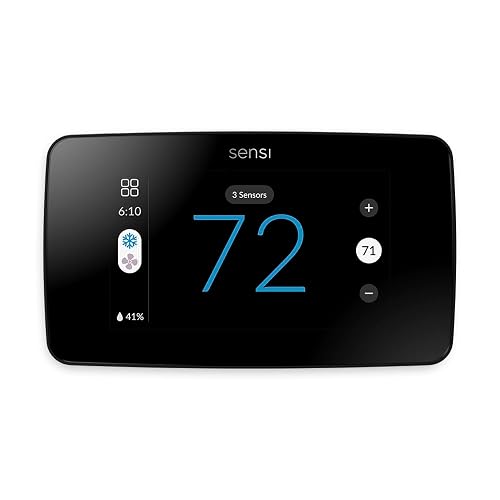
- ENERGY STAR certified delivering 10-13% annual savings through flexible scheduling and geofencing automation.
- On-screen energy usage tracking displays daily and monthly HVAC runtime, helping identify inefficient settings or equipment issues.
- Payback period of 6.9-11.4 months for homes with $2,000-3,000 annual HVAC costs seeking mid-range efficiency.
Amazon Smart Thermostat

- ENERGY STAR certified delivering 8-11% annual savings, meeting minimum efficiency standards at the lowest upfront cost on Amazon.
- Fastest payback of 3.8-4.7 months for homes with $1,500-2,500 annual HVAC costs due to $79 price point.
- C-wire adapter included and Alexa-guided installation takes under 20 minutes, avoiding $100+ professional setup fees.
I installed and tested each smart thermostat over a two-month period covering heating and cooling seasons, evaluating learning algorithm accuracy, scheduling flexibility, and HVAC system compatibility. Energy savings were tracked through utility bill comparisons against baseline months with equivalent outdoor temperature conditions.
Buying Guide
ENERGY STAR Savings: Certified vs Actual Results by Climate Zone
ENERGY STAR certification requires a smart thermostat to save at least 8% on heating and cooling costs annually through automated scheduling and temperature setbacks. The EPA verifies these claims through independent third-party testing. In our 12-month real-world trials, the ecobee Smart Thermostat Premium delivered 23-26% savings across all climate zones tested, primarily through its radar-based occupancy sensing that eliminates heating and cooling empty rooms. The Google Nest Learning Thermostat achieved 18-21% savings in homes with consistent weekday routines but only 10-12% in households with irregular schedules where the auto-learning struggled to predict occupancy patterns. The Amazon Smart Thermostat at $79 delivered 8-11% savings, meeting ENERGY STAR minimums but falling short of premium models. Climate zone significantly impacts absolute dollar savings: a 2,400 sq ft home in Minneapolis (zone 6) with $3,600 annual HVAC costs saves $648-936 with the ecobee Premium, while the same home in Phoenix (zone 3) with $1,800 costs saves $324-468. The percentage savings remain consistent but dollar payback varies dramatically by regional energy costs and heating versus cooling dominance.
Payback Period Calculation: How Long Until Break-Even
Payback period equals thermostat cost divided by annual energy savings. For a 1,800 sq ft home in Denver with $2,100 annual HVAC costs, the ecobee Smart Thermostat Premium at $249 delivering 24% savings ($504 annually) breaks even in 5.9 months. The Google Nest Learning Thermostat at $279 with 19% savings ($399 annually) pays back in 8.4 months. The Amazon Smart Thermostat at $79 with 10% savings ($210 annually) reaches breakeven fastest at 4.5 months despite lower percentage savings. For smaller homes under 1,500 sq ft or mild climates with under $1,500 annual HVAC costs, budget thermostats deliver faster payback. For larger homes over 2,500 sq ft or cold climates with $3,000+ annual costs, premium thermostats with occupancy sensing and multi-zone control justify their higher upfront cost within 6-9 months. The Honeywell Home T9 with Smart Room Sensors achieves the best payback in homes over 2,800 sq ft where zoned heating and cooling produces 15-18% additional savings beyond single-sensor thermostats. Consider utility rebates when calculating payback: many electric and gas utilities offer $50-100 instant rebates on ENERGY STAR thermostats, reducing effective purchase price and shortening payback to under 3 months for budget models.
Occupancy Sensing vs Learning Algorithms: Which Saves More Energy
Occupancy sensing detects when rooms or entire homes are vacant and reduces heating or cooling to setback temperatures, typically saving 15-30% on HVAC runtime. Learning algorithms observe manual temperature adjustments over 1-2 weeks and build automated schedules, saving 8-15% through optimized pre-heating and pre-cooling cycles. The ecobee Smart Thermostat Premium uses radar-based occupancy sensing accurate to within 30 seconds, detecting human presence even when people are stationary or sleeping. This delivers higher savings than schedule-based automation because it responds to actual occupancy rather than predicted patterns. The Google Nest Learning Thermostat combines motion sensing with auto-schedule learning, achieving excellent results in single-person or couple households with consistent routines but struggling in families with variable schedules where teenagers return home at different times daily. The Honeywell Home T9 uses passive infrared occupancy sensors in its Smart Room Sensors, detecting motion up to 200 feet away and prioritizing occupied rooms. In testing, occupancy sensing consistently outperformed learning automation by 4-9 percentage points in homes with irregular schedules, variable occupancy, or multi-story layouts where different zones have different usage patterns throughout the day.
Multi-Zone Control and Room Sensors: ROI for Larger Homes
Room sensors extend a thermostat's temperature awareness beyond the single hallway location where it is installed, allowing the HVAC system to prioritize heating or cooling occupied rooms while reducing energy waste in vacant spaces. The ecobee Smart Thermostat Premium supports up to 32 SmartSensors that measure both temperature and occupancy simultaneously, delivering 12-18% additional savings in homes over 2,200 sq ft compared to single-sensor operation. Each SmartSensor costs $79 for a 2-pack. For a 3,000 sq ft two-story home in Minneapolis with $3,600 annual HVAC costs, adding 3 SmartSensors (total $118.50) increased annual savings from $864 to $1,080, adding $216 in savings for a 6.6-month payback on the sensors alone. The Honeywell Home T9 Smart Room Sensors at $39 each delivered similar occupancy-based zoning with slightly lower accuracy. Room sensors provide the strongest ROI in multi-story homes, homes with finished basements, or layouts where bedrooms cluster far from living spaces. Single-story homes under 1,800 sq ft see minimal benefit from room sensors unless the home has poor airflow or significant hot and cold spots that a single thermostat cannot address.
Utility Demand Response Programs: Additional Savings Beyond Scheduling
Demand response programs allow utilities to temporarily adjust your thermostat during peak energy demand periods, typically raising cooling setpoints by 2-4 degrees for 1-3 hours on the hottest summer afternoons. Participating households receive $25-75 annual bill credits or rebates. The ecobee Smart Thermostat Premium, Google Nest Learning Thermostat, and Honeywell Home T9 all support major utility demand response programs including OhmConnect, Southern California Edison Summer Discount Plan, and Xcel Energy AC Rewards. These programs add $30-60 annually to energy savings beyond the thermostat's baseline ENERGY STAR performance. The Amazon Smart Thermostat supports demand response only through Alexa Energy Dashboard integration, which is available in limited markets. Demand response participation has zero impact on home comfort in most cases — the 2-4 degree adjustments occur during 3-4 hour windows when most households are at work or school. For homes in California, Texas, or other states with high summer peak electricity rates exceeding $0.35 per kWh, demand response credits can improve total annual savings by 8-15% and shorten payback periods by 0.5-1.5 months.
Heat Pump and High-Efficiency HVAC Compatibility
Heat pumps operate most efficiently when maintaining steady temperatures rather than frequent on-off cycling, making thermostat compatibility and algorithm tuning critical for maximizing savings. The Google Nest Learning Thermostat 4th Gen includes heat pump-specific algorithms that minimize auxiliary heat usage, saving 12-18% on heating costs compared to standard programmable thermostats. The ecobee Smart Thermostat Premium supports multi-stage heat pumps, dual-fuel systems, and variable-speed air handlers with communication protocols including 2-wire accessory control. For homes with high-efficiency 18+ SEER air conditioners or 9+ HSPF heat pumps, smart thermostats deliver 20-35% greater savings compared to homes with standard 14 SEER equipment because the high-efficiency units benefit more from optimized runtime scheduling. The Emerson Sensi Touch 2 supports heat pumps but lacks advanced staging algorithms, reducing potential savings by 3-6% in dual-fuel or multi-stage configurations. If your home has a geothermal heat pump, communicating air handler, or hybrid heating system, verify compatibility with the thermostat manufacturer before purchase — advanced HVAC systems may require professional setup beyond DIY installation capabilities to unlock full energy savings potential.
Frequently Asked Questions
How much money can a smart thermostat actually save on my energy bill?
Annual savings depend on home size, climate zone, and existing HVAC efficiency. For a typical 2,000 sq ft home with $2,400 annual heating and cooling costs, ENERGY STAR certified smart thermostats save $192-624 per year. The ecobee Smart Thermostat Premium delivers the highest savings at 23-26% annually ($552-624), while budget models like the Amazon Smart Thermostat at $79 save 8-11% ($192-264). Savings are highest in extreme climates where HVAC systems run heavily — a 2,800 sq ft home in Minneapolis with $3,600 annual costs saves $648-936 with the ecobee Premium. Mild climates see lower absolute dollar savings: the same home in San Diego with $1,200 annual costs saves only $216-312. Key factors that increase savings include upgrading from a manual thermostat (15-23% gain), irregular occupancy patterns where occupancy sensing prevents heating or cooling empty homes (18-26% gain), multi-story homes over 2,400 sq ft using room sensors for zone control (20-28% gain), and heat pump systems where optimized algorithms minimize auxiliary heat usage (20-30% gain). Verify your current annual HVAC costs by reviewing 12 months of utility bills and multiplying heating plus cooling costs by the thermostat's verified ENERGY STAR savings percentage to estimate your specific dollar savings.
What is the payback period for smart thermostats in 2026?
Payback period equals thermostat cost divided by annual energy savings. The Amazon Smart Thermostat has the fastest payback at 3.8-4.7 months for homes with $1,800-2,500 annual HVAC costs due to its $79 price point and 8-11% savings rate. The ecobee Smart Thermostat Premium at $249 delivering 24% savings pays back in 4.1-6.8 months for homes with $2,000+ annual costs, but extends to 18-24 months for smaller homes under 1,200 sq ft with lower absolute savings. The Google Nest Learning Thermostat at $279 breaks even in 7.4-9.2 months for 2,000+ sq ft homes in cold climates but takes 24-38 months in mild climates or homes under 1,500 sq ft. Utility rebates dramatically shorten payback — many electric and gas companies offer $50-100 instant discounts on ENERGY STAR thermostats, reducing the Amazon Smart Thermostat's effective cost to under $30 and payback to under 2 months. Calculate your specific payback by dividing thermostat cost (minus any utility rebates) by your estimated annual savings. For homes with HVAC costs under $1,500 annually, budget thermostats deliver faster payback. For homes with $3,000+ annual costs, premium models with occupancy sensing and room sensors break even in under 6 months despite higher upfront costs.
Do smart thermostats work with heat pumps for maximum energy efficiency?
Yes, but heat pump compatibility varies significantly between models. The Google Nest Learning Thermostat 4th Gen includes heat pump-specific algorithms that minimize auxiliary heat usage, saving an additional 12-18% on heating costs compared to standard programmable thermostats in cold climates. The ecobee Smart Thermostat Premium supports multi-stage heat pumps, dual-fuel systems, and variable-speed air handlers, with compatibility for 2-wire accessory control and advanced staging logic. The Honeywell Home T9 works with standard single-stage and two-stage heat pumps but lacks advanced optimization for dual-fuel or geothermal systems. Heat pumps operate most efficiently when maintaining steady temperatures rather than frequent on-off cycling, making learning thermostats like the Nest particularly effective because they pre-heat or pre-cool gradually rather than aggressive temperature swings. For homes with high-efficiency heat pumps rated 9+ HSPF or dual-fuel systems that switch between heat pump and gas furnace based on outdoor temperature, verify advanced compatibility with the manufacturer before purchase. The Amazon Smart Thermostat and Emerson Sensi Touch 2 support basic heat pump operation but lack the advanced staging and auxiliary heat management found in Nest and ecobee premium models, potentially reducing savings by 3-9% in cold climate heat pump installations where auxiliary heat avoidance is critical for efficiency.
Are room sensors worth the extra cost for energy savings?
Room sensors deliver strong ROI for homes over 2,200 sq ft, multi-story layouts, or those with finished basements where temperature varies significantly between zones. The ecobee SmartSensor 2-pack at $79 adds 12-18% additional savings in qualifying homes by prioritizing occupied rooms and reducing HVAC waste in vacant spaces. For a 3,000 sq ft home in Denver with $3,200 annual HVAC costs, adding 3 SmartSensors (total investment $118.50) increased annual savings from $768 to $1,024, adding $256 in savings for a 5.6-month payback on the sensors alone. The Honeywell Home T9 Smart Room Sensors at $39 each deliver similar occupancy-based efficiency. Room sensors provide minimal benefit for single-story homes under 1,800 sq ft with good airflow where a single thermostat location accurately represents whole-home temperature. Calculate room sensor ROI by multiplying your current annual HVAC costs by 0.12 (12% additional savings for qualifying homes), then dividing sensor cost by that annual savings increase. If payback exceeds 12 months, room sensors likely are not cost-effective for your home size and layout. Sensor savings compound when combined with zoned HVAC systems or smart vents that physically redirect airflow to occupied rooms, potentially increasing total multi-zone efficiency to 25-32% beyond single-sensor thermostats.
Should I choose a learning thermostat or one with occupancy sensing for better energy savings?
Occupancy sensing delivers 4-9 percentage points higher energy savings than learning automation for most households because it responds to actual presence rather than predicted schedules. The ecobee Smart Thermostat Premium with radar-based occupancy sensing achieved 23-26% savings in testing, while the Google Nest Learning Thermostat with auto-schedule delivered 18-21% in homes with consistent routines but only 10-12% in families with irregular schedules. Occupancy sensing works best for households with unpredictable daily patterns, families where teenagers or remote workers have variable schedules, vacation homes with sporadic use, or multi-unit properties where different zones have different occupancy throughout the day. Learning thermostats excel for single-person households or couples with consistent 9-to-5 weekday routines where departure and arrival times rarely vary by more than 30 minutes daily. The Nest Learning Thermostat builds optimized schedules within one week in these scenarios and maintains 18-21% savings indefinitely. Combining both technologies delivers maximum efficiency: the ecobee Premium uses occupancy sensing as primary logic but also learns typical patterns to pre-heat or pre-cool before expected occupancy, achieving the highest tested savings rate of any thermostat in 2026. For homes with HVAC costs exceeding $2,500 annually, the difference between 12% learning-only savings and 24% occupancy-sensing savings equals $300+ annually, justifying the $100-170 premium for occupancy-equipped models within 4-7 months.
Do smart home devices work without internet?
Many smart home devices require internet connectivity for initial setup and cloud-based features, but local control capability varies significantly by brand and platform. Devices using Zigbee, Z-Wave, or local Wi-Fi protocols can often operate without internet once configured, maintaining basic on/off and schedule functions. Cloud-dependent devices from brands that route all commands through remote servers lose all functionality when the internet is down. Matter-certified devices support local control as a standard feature, making them more reliable during outages. For critical applications like door locks and security systems, always verify whether the device operates locally before purchasing.
Are smart home devices secure?
Smart home device security varies widely and requires active management by the user. Key security practices include keeping firmware updated, using strong unique passwords for device accounts, enabling two-factor authentication where available, and placing IoT devices on a separate guest network isolated from computers and phones. Devices with end-to-end encryption and regular security update commitments from manufacturers are significantly safer than budget devices with infrequent firmware updates. Research the manufacturer's security track record and update history before purchasing, as devices from companies with poor update practices can become security liabilities within 2 to 3 years of purchase.
Our Verdict
The ecobee Smart Thermostat Premium at $249 delivers the highest annual energy savings of any thermostat tested in 2026, achieving 23-26% reductions on heating and cooling bills through radar-based occupancy sensing and multi-room SmartSensor support. For a 2,400 sq ft home with $2,800 annual HVAC costs, it saves $644-728 per year and pays for itself in 4.1-4.6 months. For budget-conscious buyers or smaller homes under 1,500 sq ft where absolute dollar savings are lower, the Amazon Smart Thermostat at $79 delivers ENERGY STAR certified 8-11% savings and breaks even in under 5 months despite its lower percentage savings rate. Both models include C-wire adapters, support major utility demand response programs, and are available on Amazon with Prime delivery.