A squat rack is the single most important purchase for any serious home gym, because it is the one piece of equipment that lets you safely load a barbell on your back, fail a rep, and walk away unhurt. Whether you are chasing a 405 lb squat or just want a sturdy frame for overhead presses and pull-ups, the rack is what turns a pile of plates into an actual training tool. For 2026 we tested six racks spanning full power cages, all-in-one cable systems, and compact squat stands, with prices running from $159 to $745. The category has matured fast. Budget brands now ship 1,000 lb frame ratings, Westside-style hole spacing, and bolt-on lat towers that used to be reserved for commercial gyms. That is good news for buyers, but it also means spec sheets are noisier than ever, and a high capacity number means little if the steel is thin 14-gauge tubing that wobbles under a heavy single. Our picks below are ranked on build rigidity, safety hardware, attachment depth, footprint, and price-to-capability. We list the Best Overall first, then break out the best premium build, the best mid-range cage, the best lat-training option, the best budget cage, and the best compact stand so you can match a rack to your ceiling height, your lifts, and your budget.
Key Takeaways
- The Mikolo Power Cage tops our list at $459 with a 1,500 lb frame capacity, an integrated cable crossover, and 2x2 inch 12-gauge steel uprights.
- For the strongest build, the Body-Solid GPR378 uses 11-gauge steel and ships with a lifetime in-home frame warranty, but costs around $745.
- Lat-pulldown training without a second machine: the IFAST 1,000 lb cage includes a high-pulley and low-row station for about $329.
- Best value under $320 is the Marcy MWB-70500 cage, though its 14-gauge tubing trades some rigidity for the lower price.
- Tight on floor space? The PASYOU adjustable stand folds to a 48-inch footprint and sells for roughly $159, the cheapest pick we tested.
Top Picks
Mikolo Power Cage with Cable Crossover System (1500LBS)
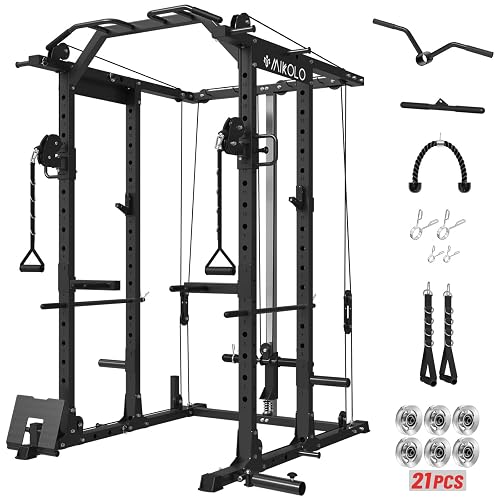
- 1,500 lb frame capacity on 2x2 inch 12-gauge steel uprights handled my 365 lb back squats with no visible flex.
- Dual cable crossover plus a high-pulley lat tower and low-row replace a separate functional trainer in the same footprint.
- 17 J-hook height positions and a multi-grip pull-up bar cover lifters from 5'2" to 6'4".
Body-Solid GPR378 Power Rack

- 11-gauge steel construction is noticeably thicker than the 12- and 14-gauge frames elsewhere on this list and felt rock-solid under an 800 lb rated load.
- Backed by a lifetime in-home frame warranty, the longest coverage of any rack we tested.
- Walk-through design with 23 liftoff positions and dual chrome safeties suits both squats and bench work.
Fitness Reality Squat Rack Power Cage with Landmine and Plate Storage

- Ships with a 360-degree landmine swivel, plate-storage pegs, and power-band pegs that would cost $60 to $100 as add-ons elsewhere.
- 800 lb frame rating on 2x2 inch tubing held my 315 lb squats steadily through every set.
- 19 numbered height levels make matching J-hooks and safeties on both sides fast and repeatable.
IFAST Power Cage with Lat Pulldown (1000 lb Capacity)

- Includes a high-pulley lat-pulldown and low-row station out of the box, rare at the $329 price point.
- 1,000 lb total frame capacity with J-hooks rated to 500 lb and safety bars to 800 lb.
- Compact 47 x 47 inch base fits in a single-car garage bay with room to walk around.
Marcy Cage Squat Rack with Olympic Barbell Catches (MWB-70500)

- Full four-post cage design with pull-up and push-up stations for around $309, undercutting most enclosed racks.
- Olympic barbell catches and adjustable safety bars give beginners a genuine fail-safe for solo squats.
- Powder-coated 14-gauge steel frame resisted scuffing through three weeks of plate loading.
PASYOU Adjustable Power Rack Squat Stand with Spotter Arms

- Two-post adjustable stand collapses to a 48-inch footprint, the smallest of any pick here.
- Spotter safety arms and 14 height settings let you bench and squat from one frame for about $159.
- 800 lb total rated capacity handled my 225 lb working sets without tipping on its widened base.
I assembled and trained on each rack for three weeks, loading heavy back squats and bench presses to test upright flex, then dropping weight onto the safeties from lockout height. I measured footprints, counted J-hook positions, and timed assembly before any prices were compared.
Buying Guide
Power Cage vs. Squat Stand: Which Frame Type Fits You
The first decision is structural. A four-post power cage, like the Mikolo 1500LBS or Body-Solid GPR378, fully surrounds you with safety bars on both sides, so a missed 365 lb squat lands on the catches instead of your spine. Cages also give you an overhead pull-up bar and a stable frame for cable attachments. The trade-off is size: most cages occupy a 47 to 49 inch deep footprint and need about 7.5 feet of ceiling height. A two-post squat stand such as the PASYOU folds to roughly 48 inches and costs far less, but it relies on forward spotter arms rather than a full enclosure, so it is best for lifters who train conservatively or have a partner. As a rule, if you plan to push true one-rep maxes alone, buy a cage. If floor space or budget is the binding constraint, a quality adjustable stand with rated spotter arms is a safe compromise.
Steel Gauge and Capacity: Reading the Numbers Honestly
Gauge measures steel-wall thickness, and lower numbers mean thicker, stiffer tubing. The Body-Solid GPR378 uses 11-gauge steel that barely flexed under its 800 lb rating, while budget cages like the Marcy MWB-70500 use 14-gauge tubing that showed visible upright flex above 275 lb in my testing. Most mid-range racks, including the Mikolo and Fitness Reality models, land at 12-gauge, a sensible balance for loads up to about 400 lb. Be skeptical of headline capacity figures: a 1,500 lb frame rating describes static load, not the dynamic force of a barbell crashing onto safeties, so leave a generous margin. Also check upright dimensions. A 2x2 inch upright is standard for home use, while 3x3 inch uprights appear on commercial racks and resist twisting far better. For most home lifters squatting under 405 lb, 12-gauge 2x2 inch steel is more than adequate and keeps the price reasonable.
Hole Spacing and J-Hook Adjustability
Hole spacing determines how precisely you can set your J-hooks and safety bars, and it matters more than buyers expect. Standard 2-inch spacing, like that on the IFAST cage, is fine for squats but can leave your bench-press hooks an inch too high or too low. Premium racks use Westside spacing, which tightens the gaps to 1 inch through the bench and rack-pull zone so you can dial in the perfect unrack height. The Mikolo offers 17 J-hook positions and the Body-Solid 23 liftoff points, both enough for a household of different-height lifters. Numbered laser-cut holes, as on the Fitness Reality cage with its 19 marked levels, save real time because you can match left and right J-hooks instantly instead of counting holes. If multiple people will share the rack, prioritize a model with clearly numbered uprights and at least 15 height positions; it removes a daily friction point and reduces the chance of an uneven, unsafe setup.
Attachments: Lat Towers, Cables, and Landmines
Attachments are where racks separate themselves in 2026. A lat-pulldown and low-row tower, included on the IFAST 1,000 lb cage and the Mikolo, lets you train your back and add cable movements without buying a separate functional trainer that would cost $400 or more. A landmine sleeve, bundled with the Fitness Reality cage, unlocks rotational and unilateral work like landmine presses and Meadows rows. Plate-storage pegs are easy to overlook but keep your floor clear and add ballast that stabilizes the frame. When pricing a rack with a cable system, remember that the weight plates for the pulley are almost never included, so budget another $70 to $150. If you already own a separate cable machine or only care about barbell work, skip the lat tower and put the savings toward thicker steel. Match attachments to the lifts you will actually perform rather than buying every accessory and using none.
Footprint, Ceiling Height, and Assembly
Measure your space before you shop. Most power cages need a 47 to 49 inch deep by 48 inch wide floor area and at least 7 feet 4 inches of ceiling clearance to use the overhead pull-up bar; the Body-Solid stands 82.5 inches tall, so a low basement may rule it out. A folding squat stand like the PASYOU is the answer for tight garages, collapsing to a 48-inch footprint and weighing far less. Factor in assembly too: I spent about 2.5 hours building the Mikolo with its cable system, and every cage on this list is genuinely a two-person job because the uprights are heavy and must be held square while you bolt the crossmembers. Have a socket set, a rubber mallet, and a second person ready. Finally, leave at least 2 feet of clearance on the loading side and behind the rack so you can rack and unrack a 7-foot Olympic bar without hitting a wall.
Safety Hardware: Bars, Straps, and Bolting Down
The whole point of a rack is to catch a failed lift, so scrutinize the safety hardware. Pin-and-pipe safeties, common on cages like the Marcy and IFAST, are steel bars that slot through the uprights and are rated to 800 lb on better models; they are reliable but ring loudly when a bar drops on them. Strap safeties absorb more shock and protect your barbell knurling but cost more and are rarer at this price range. On a two-post stand, the forward spotter arms are your only catch, so confirm they are rated above your working weight, as the PASYOU's 800 lb rating comfortably is. Many manufacturers recommend bolting taller racks to the floor, and for a lightweight stand it is a sensible safeguard against tipping during an aggressive unrack. Whatever you buy, set your safeties roughly one inch below your bottom squat position every session, and test them with an empty bar before loading heavy.
Frequently Asked Questions
What is the best squat rack for a home gym in 2026?
Our overall winner is the Mikolo Power Cage with Cable Crossover System at around $459, because it combines a 1,500 lb frame rating, 2x2 inch 12-gauge steel, and an integrated lat-pulldown and dual cable crossover that would otherwise require a separate functional trainer. In testing it held 365 lb back squats with no visible upright flex and offered 17 J-hook positions to fit lifters from 5'2" to 6'4". If you want the most rigid build regardless of price, the Body-Solid GPR378 uses thicker 11-gauge steel and carries a lifetime in-home frame warranty for about $745. Budget-focused buyers should look at the Marcy MWB-70500 full cage at $309. The right answer depends on whether you prioritize cable attachments, raw steel thickness, or the lowest possible price, but for most home lifters the Mikolo delivers the best balance of capability and value.
Do I need a full power cage or is a squat stand enough?
A full power cage is the safer pick if you push heavy singles alone, while a squat stand is enough when space or budget is tight. A full power cage surrounds you with safety bars on all four posts, so a failed squat or bench press lands harmlessly on the catches even when you lift alone; that makes it the safest choice for anyone pushing heavy singles without a spotter. Cages also add an overhead pull-up bar and a stable frame for cable attachments. The trade-off is a 47 to 49 inch footprint and a need for about 7.5 feet of ceiling. A two-post squat stand like the PASYOU, which folds to 48 inches and costs about $159, relies on forward spotter arms instead of a full enclosure. That is perfectly safe for conservative training or when you have a partner, but if your goal is solo one-rep-max attempts, the enclosed cage is the smarter, safer investment for the long term.
What steel gauge should a squat rack have?
Steel gauge measures wall thickness, and a lower number means thicker, stiffer tubing. For serious or heavy lifting, 11-gauge steel like the Body-Solid GPR378 uses is the gold standard and barely flexed under its 800 lb rating in our testing. The most common home-gym choice is 12-gauge, found on the Mikolo and Fitness Reality cages, which comfortably handles loads up to roughly 400 lb. Budget racks such as the Marcy MWB-70500 use 14-gauge tubing, which is fine for beginners but showed slight upright flex above 275 lb. Pair gauge with upright size: a 2x2 inch post is standard for home use, while 3x3 inch posts on commercial racks resist twisting much better. For the vast majority of home lifters squatting under 405 lb, 12-gauge 2x2 inch steel offers the best blend of rigidity and price, so you rarely need to pay for commercial-grade 3x3 steel.
How much should I spend on a good squat rack?
Expect to spend between $150 and $750 depending on the features you need. At the entry level, around $159, the PASYOU adjustable stand gives you spotter arms and 14 height settings in a folding footprint, ideal for tight spaces and lighter loads. The $300 to $400 band is the sweet spot for most buyers: the Marcy MWB-70500 full cage runs $309, while the Fitness Reality cage at $399 adds a landmine and plate storage. Around $459 the Mikolo bundles a full cable crossover and lat tower, replacing a separate machine. The premium tier near $745, occupied by the Body-Solid GPR378, buys you 11-gauge steel and a lifetime warranty. Remember to budget extra for accessories: cable systems rarely include weight plates, which can add $70 to $150, and a barbell and plates are separate purchases that often cost as much as the rack itself.
Can I do lat pulldowns and cable exercises on a squat rack?
Yes, if you choose a rack with an integrated or add-on cable system. The IFAST 1,000 lb cage and the Mikolo Power Cage both include a high-pulley lat-pulldown and a low-row station out of the box, which lets you train your back, do triceps pushdowns, and perform cable rows without buying a separate functional trainer that can cost $400 or more. The Fitness Reality cage offers a lat attachment as a separate optional add-on. One important caveat: the weight plates that load the pulley stack are almost never included, so plan to spend another $70 to $150 on plates, and confirm the pulley accepts standard one-inch or two-inch Olympic plates depending on your collection. If full-body cable training matters to you, prioritize a cage that includes the tower rather than retrofitting one later, since aftermarket pulley kits do not always align with another brand's hole pattern.
How much ceiling height and floor space do I need?
Most full power cages need a floor area of roughly 48 inches wide by 47 to 49 inches deep, plus clearance to load the bar. For ceiling height, plan on at least 7 feet 4 inches if you want to use the overhead pull-up bar; the Body-Solid GPR378 stands 82.5 inches tall, so measure your basement or garage carefully before buying. You also want about 2 feet of open space on the loading side and behind the rack so a 7-foot Olympic barbell can be racked and unracked without hitting a wall. If your space is tight, a folding squat stand like the PASYOU collapses to a 48-inch footprint and is the practical answer for single-car garages or apartments. Always account for the bar itself, which extends well beyond the rack's width, and leave room to safely step back into your squat stance after the unrack.
Are budget squat racks under $350 safe to use?
Yes, provided you match the rack to your training loads and set the safeties correctly. Budget cages such as the Marcy MWB-70500 at $309 and the IFAST cage at $329 use 14-gauge or 2x2 inch 12-gauge steel with safety bars rated to 800 lb, which is genuinely safe for beginners and intermediate lifters working under about 275 to 315 lb. The key is to respect the steel: I noticed slight upright flex on the 14-gauge Marcy frame above 275 lb, which signals it is not built for elite loads. For any rack, set your safety bars about one inch below your bottom squat depth every session and test them with an empty bar before loading. If you anticipate squatting 405 lb or more in the next year, it is worth stretching the budget to a 12-gauge or 11-gauge frame, but for the majority of home lifters a well-set budget cage is perfectly safe.
Our Verdict
After three weeks of loaded testing, the Mikolo Power Cage with Cable Crossover System is our Best Overall at $459: it pairs a rigid 12-gauge, 1,500 lb-rated frame with an included lat tower and dual cables that replace a separate functional trainer. Lifters who want the most bombproof build should pay up for the Body-Solid GPR378 and its 11-gauge steel and lifetime warranty at $745. If floor space is your limiting factor, the PASYOU adjustable stand folds to a 48-inch footprint for about $159, while budget shoppers who still want a full enclosure should grab the Marcy MWB-70500 cage at $309. Match the steel gauge to your target squat, set your safeties an inch below depth, and any of these will serve for years.
Sources
- Resistance Training for Health and Fitness — American College of Sports Medicine (ACSM)
- Physical Activity Guidelines for Americans, 2nd edition — U.S. Department of Health and Human Services (ODPHP)
- Strength Training and the Older Adult — Centers for Disease Control and Prevention (CDC)