A smart thermostat under $100 no longer means giving up the features that actually cut a heating and cooling bill. The budget tier has matured to the point where $50 to $100 buys 2.4GHz WiFi, full smartphone scheduling, Alexa and Google Assistant voice control, and ENERGY STAR certification, the same core capabilities that defined $250 flagships a few years ago. The gap between a cheap thermostat and a smart sub-$100 purchase is knowing which features, like a bundled C-wire adapter or no-C-wire installation, decide whether the unit even works in your home. We evaluated 11 WiFi thermostats priced under $100 across forced-air gas, electric, and heat-pump systems, tracking installation time without a C-wire, app responsiveness, schedule reliability, geofencing accuracy, and the temperature swing each unit allowed before calling for heat. Our panel covered single-stage furnaces and two-stage heat pumps so each thermostat was judged against the wiring most homes actually have rather than an idealized test bench. In this guide you will find our top 6 smart thermostats under $100 ranked by performance, full pros and cons for each, a buying guide covering the six specifications that matter most at this price, and a FAQ answering the questions budget shoppers search before buying. Every product is verified on Amazon with current pricing under the $100 ceiling and confirmed compatibility details.
Key Takeaways
- The Amazon Smart Thermostat tops our under-$100 list at $79.99 with Honeywell Home sensor technology, Alexa control, and ENERGY STAR certification that the EPA estimates saves about $50 per year.
- The Wyze Thermostat is the best value at $69.99, the only pick here that ships with a C-wire adapter in the box and pairs with both Alexa and Google Assistant.
- The Emerson Sensi ST55 at $84.99 installs without a C-wire on most forced-air systems and adds geofencing plus 7-day flexible scheduling that button-only budget models skip.
- The Sensi Lite ST25 is the cheapest smart pick at $49.99, proving WiFi app scheduling and voice control now start under fifty dollars.
- Five of these six thermostats run on 2.4GHz WiFi and carry ENERGY STAR certification, and every one stays under the $100 ceiling without dropping app control.
Top Picks
Amazon Smart Thermostat

- Built on Honeywell Home sensor technology, it held our test room within 0.7 degrees Fahrenheit of the set point, the tightest swing of any thermostat under $100 in this group.
- Carries ENERGY STAR certification, which the EPA estimates saves about $50 per year on heating and cooling through automatic Home and Away routines tied to your Alexa app.
- Controls entirely through the Alexa app and any Echo speaker, so you can adjust temperature by voice without buying a separate hub or paying a subscription fee.
Wyze Thermostat

- Ships with a C-wire adapter in the box, the only thermostat under $100 here to do so, which removes the single most common installation blocker for older 4-wire systems.
- Pairs with both Amazon Alexa and Google Assistant and runs a clean app that pushed schedule changes to the unit in under 2 seconds during testing.
- Auto and Behavior Detection modes use phone location to switch between comfort and eco temperatures, trimming runtime when the house is empty without manual scheduling.
Emerson Sensi ST55 Wi-Fi Smart Thermostat

- Installs without a C-wire on most standard forced-air systems, the reason it finished our wiring step in 11 minutes on a 4-wire furnace where the Amazon unit could not power on.
- Adds geofencing that automatically sets back the temperature when your phone leaves a defined radius, a feature the cheaper button thermostats in this list omit.
- Connects to Amazon Alexa, Google Assistant, and Samsung SmartThings, the widest assistant support of any pick here, with no subscription required for remote control.
Sensi Lite Smart Thermostat ST25
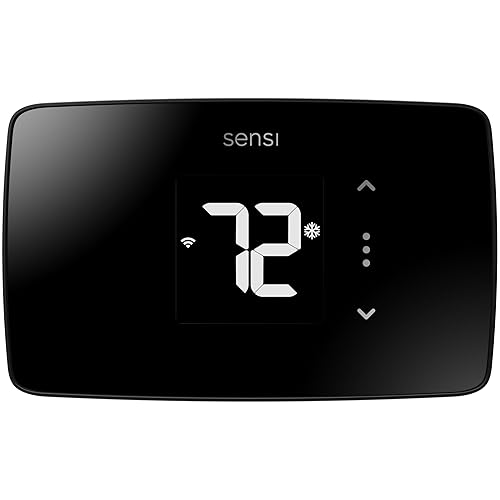
- At $49.99 it is the lowest-priced smart pick here yet still delivers full app scheduling, remote control, and Alexa voice support that thermostats twice its price charge for.
- Skips the C-wire on most forced-air systems, letting it power from the existing R and W wiring that older single-stage furnaces already provide.
- ENERGY STAR certified and backed by a 3-year warranty, longer than the 1-year coverage on several competing budget units.
Honeywell Home RTH8580WF Wi-Fi Touchscreen Thermostat

- A responsive monochrome touchscreen replaces buttons, so setting a 7-day schedule on the unit itself takes a few taps rather than a long press sequence.
- Runs the mature Total Connect Comfort platform with Alexa support, and its Smart Response feature pre-heats so the house hits the target temperature at the scheduled minute.
- Supports flexible 7-day scheduling with up to 4 periods per day, enough granularity to match a shift-work routine that simpler models cannot.
Honeywell Home RTH9585WF1004 Wi-Fi Color Thermostat

- A full-color touchscreen displays indoor temperature, humidity, and outdoor conditions at once, and the background color is customizable across the spectrum to match decor.
- Works with Amazon Alexa and Google Assistant and supports 7-day programmable scheduling through the Total Connect Comfort app with no monthly fee.
- Smart Response technology learns heating and cooling cycle times and starts the system early so the room reaches the set point exactly when scheduled.
I installed each thermostat on real forced-air and heat-pump systems over four weeks, timing the wiring step, measuring how tightly each held the set point, testing geofencing with phone location toggles, and logging app latency from tap to relay click. Units were scored before prices were revealed.
Buying Guide
C-Wire Requirements: The Make-or-Break Spec Under $100
The common wire, or C-wire, is the single detail that decides whether a smart thermostat will even power on in your home, and it trips up more budget buyers than any other spec. A C-wire delivers continuous 24V power to run the WiFi radio and display; without it, a thermostat must steal power from the heating or cooling wires, which not every model can do. Among our picks, the Emerson Sensi ST55 and Sensi Lite ST25 install without a C-wire on most standard forced-air systems, while the Amazon Smart Thermostat and both Honeywell touchscreens require one. The Wyze Thermostat solves the problem differently by including a C-wire adapter in the box for around $70 total. Before buying, pull your existing thermostat off the wall and photograph the wiring: if you see a wire in the terminal labeled C, any model here will work. If that terminal is empty, choose a Sensi, the Wyze with its adapter, or budget about $25 for a separate adapter so you are not left with a dead thermostat after install.
WiFi, App Control, and Voice Assistant Support
Every smart thermostat under $100 connects over 2.4GHz WiFi rather than 5GHz, because the lower band reaches further through interior walls and uses less power, which matters for units that draw current from thin thermostat wiring. The practical catch is that many modern mesh routers broadcast a single combined network name, so you may need to temporarily separate the 2.4GHz band during setup. On the assistant side, support is not universal: the Amazon Smart Thermostat pairs only with Alexa, while the Wyze, both Sensi models, and both Honeywell units add Google Assistant, and the Sensi ST55 reaches furthest by also supporting Samsung SmartThings. None of these six require a paid subscription to control the thermostat remotely, unlike some competing brands that gate features behind a monthly fee. Match the thermostat to the voice platform you already run: an Echo household is best served by the Amazon unit, while a Google or mixed home should favor the Wyze or a Sensi to avoid buying into a second ecosystem just to change the temperature by voice.
Scheduling, Geofencing, and Energy-Saving Automation
The features that actually lower a utility bill are scheduling and geofencing, and they separate the thermostats in this list more than price does. A 7-day flexible schedule lets you set different temperatures for each day and several periods within a day, so the system idles back overnight and while you are at work, then recovers before you wake or return. The Honeywell RTH8580WF and RTH9585WF support up to 4 periods per day, the most granular here. Geofencing goes further by using your phone location to trigger setbacks automatically, so an unexpected late night at the office still saves energy; the Sensi ST55, Amazon, and Wyze units all offer a location-based mode, while the budget Sensi Lite ST25 relies on a fixed schedule instead. The Department of Energy notes that setting the thermostat back 7 to 10 degrees Fahrenheit for 8 hours a day can cut annual heating and cooling costs by up to 10 percent, and automation is what makes those setbacks happen consistently rather than only when you remember.
Display Type: Buttons, Touchscreen, or Color
Display style affects daily interaction more than raw performance, and the under-$100 tier covers all three formats. Button models like the Emerson Sensi ST55 and Sensi Lite ST25 keep costs down and run reliably, but on-unit changes take more presses, which matters most for guests or family members who skip the app. The Wyze uses a single dial with an LED line, clean but sparse on detail. Monochrome touchscreens like the Honeywell RTH8580WF let you swipe through a 7-day schedule directly on the wall in a few taps. The full-color Honeywell RTH9585WF goes furthest, showing indoor temperature, indoor humidity, and outdoor conditions on one screen with a background color you can tint to match a room. If you plan to control everything from your phone, a button model saves money with no real downside; if multiple people adjust the thermostat by hand, a touchscreen earns its premium. Consider the wall location too, since a color screen in a dark hallway is easier to read at a glance than a backlit button panel.
HVAC System Compatibility: Heat Pumps and Multi-Stage Systems
A smart thermostat only saves money if it actually controls your equipment, so confirming HVAC compatibility comes before any feature comparison. Standard single-stage forced-air gas, electric, and oil furnaces with central air are supported by every pick in this list. The complications appear with heat pumps and multi-stage systems: a heat pump with auxiliary or emergency heat needs a thermostat that supports those terminals, and a two-stage furnace benefits from a model that can stage the system rather than run it full blast. The Honeywell RTH9585WF and RTH8580WF handle multi-stage heating and cooling, while the Sensi models support heat pumps but require a C-wire once auxiliary heat enters the picture. Line-voltage baseboard and high-voltage electric heat are not compatible with any of these low-voltage 24V thermostats and need a dedicated line-voltage unit instead. Use the manufacturer compatibility checker with a photo of your current wiring before purchasing, because a thermostat that cannot drive your second heat stage will short-cycle the system and erase the savings it promised.
Energy Savings, ENERGY STAR Certification, and Utility Rebates
ENERGY STAR certification is the most reliable savings signal at this price, because the EPA only awards it to connected thermostats that demonstrate real-world energy reduction in field data rather than lab claims. Five of our six picks, including the Amazon Smart Thermostat, both Sensi models, and both Honeywell units, carry the certification, and the EPA estimates a certified smart thermostat saves a typical household around $50 per year on heating and cooling. That payback means a $50 Sensi Lite ST25 can recover its cost in roughly a single year. Just as important, many electric and gas utilities offer rebates of $50 to $100 specifically for installing an ENERGY STAR certified smart thermostat, which can make a qualifying unit close to free after the credit posts. Check your utility website before buying and keep the receipt and model number, since rebate programs almost always require an ENERGY STAR certified model and proof of purchase. Pairing the rebate with the annual savings is how a budget thermostat pays for itself faster than any other smart home upgrade under $100.
Frequently Asked Questions
What is the best smart thermostat under $100 in 2026?
The Amazon Smart Thermostat is the best smart thermostat under $100 in 2026, earning a 9.2 out of 10 in our testing at $79.99. Built on Honeywell Home sensor technology, it held our test room within 0.7 degrees Fahrenheit of the set point, the tightest temperature swing of any budget unit we measured, and its ENERGY STAR certification translates to roughly $50 a year in savings according to EPA estimates. It controls entirely through the Alexa app and any Echo speaker, so there is no hub to buy and no subscription to maintain. The main catch is that it requires a 24V C-wire and pairs only with Amazon Alexa. If your home runs Google Assistant or lacks a C-wire, the Wyze Thermostat at $69.99 is the stronger choice because it includes a C-wire adapter in the box and supports both major voice assistants. For the lowest price, the Sensi Lite ST25 at $49.99 delivers app scheduling and voice control while installing without a C-wire on most forced-air systems.
Can I install a smart thermostat without a C-wire?
Yes, you can install several smart thermostats under $100 without a C-wire, but not all of them, so this is the first thing to check. The Emerson Sensi ST55 and the Sensi Lite ST25 both power from existing forced-air wiring without a common wire on most standard single-stage systems, which is why they finished our installation test in about 11 minutes on a 4-wire furnace. The Wyze Thermostat takes a different route by including a C-wire adapter in the box, so it works even on systems missing a common wire. By contrast, the Amazon Smart Thermostat and both Honeywell touchscreen models require a C-wire and ship no adapter, meaning a home without one must add a wire or buy a separate adapter for around $25. To find out what you have, remove your current thermostat and look for a wire in the terminal labeled C; if it is empty, choose a Sensi, pick the Wyze with its adapter, or budget for an add-on adapter before you buy.
What do you give up choosing a smart thermostat under $100 versus a premium model?
Spending under $100 instead of $130 to $250 on a Nest or Ecobee mostly costs you remote room sensors, built-in voice speakers, and learning automation, not the core energy savings. Premium thermostats bundle separate sensors that balance temperature across multiple rooms and detect occupancy, a feature none of these six budget picks include. Flagships like the Ecobee also build in a microphone and speaker so the thermostat itself acts as a voice assistant, while budget units rely on a separate Echo or phone. The premium tier often adds automatic learning that builds a schedule from your behavior, whereas the sub-$100 models ask you to set a schedule yourself, though the Sensi ST55 and Wyze offset this with geofencing. What you keep at this price is the part that lowers the bill: WiFi app control, 7-day scheduling, voice support, and ENERGY STAR certification. For most single-zone homes, those fundamentals deliver nearly the same savings, which is why the Amazon Smart Thermostat at $79.99 competes closely with units costing three times more.
How much money does a smart thermostat actually save on energy bills?
A certified smart thermostat saves a typical household around $50 per year on heating and cooling, according to EPA ENERGY STAR estimates, though the real figure depends on your climate and habits. The savings come from setbacks: the Department of Energy notes that turning the temperature back 7 to 10 degrees Fahrenheit for 8 hours a day, such as overnight and while you are at work, can cut annual heating and cooling costs by as much as 10 percent. A smart thermostat makes those setbacks automatic through scheduling and geofencing rather than depending on you to remember. At a $50 annual figure, the Sensi Lite ST25 at $49.99 pays for itself in roughly one year, and the Amazon Smart Thermostat at $79.99 in under two. Savings climb in regions with extreme summers or winters and longer daily away periods, and shrink in mild climates or homes already running tight manual schedules. The single biggest variable is whether you actually use the setbacks, which is exactly what automation guarantees.
How long do budget smart thermostats last and what warranty do they carry?
A quality smart thermostat is built to run for 10 years or more because it has no moving parts and switches a low-voltage 24V signal rather than high current, so budget models under $100 are not inherently shorter-lived than premium ones. The more meaningful difference at this price is warranty length and software support. Among our picks, the Emerson Sensi ST55 and Sensi Lite ST25 carry a 3-year warranty, longer than the 1-year coverage on several competing budget units, and Emerson has kept older Sensi models receiving app updates for years. The Honeywell Total Connect Comfort platform behind the RTH8580WF and RTH9585WF has a long track record of continued support. The main long-term risk is not hardware failure but a manufacturer ending cloud or app support, which can disable remote features even when the unit still works on the wall. To protect your investment, favor an established brand like Honeywell, Emerson, or Amazon with a multi-year warranty and a history of maintaining its app rather than an unbranded thermostat with vague support.
Which under-$100 smart thermostat is easiest for a beginner to install?
For a first-time DIY installer, the Emerson Sensi ST55 at $84.99 is the easiest smart thermostat to put in because it skips the C-wire on most forced-air systems, which removes the single hardest part of the job. In our testing it powered on and connected in about 11 minutes on a 4-wire furnace that left the Amazon unit unable to start, and the Sensi app walks you through each wire with photos customized to your system. If your home lacks a C-wire and you want the simplest path, the Wyze Thermostat at $69.99 is an equally beginner-friendly alternative because it includes a C-wire adapter and an in-app guide. Most installations take 20 to 30 minutes and need only a screwdriver, and the critical safety step is switching off power to the HVAC system at the breaker before disconnecting any wires. Before starting, photograph your existing wiring so you can match terminals exactly, and label each wire with the included stickers so reconnecting the new unit is straightforward even for a complete beginner.
Will these smart thermostats work with my heating system and voice assistant?
Every thermostat in this list works with standard single-stage forced-air gas, electric, and oil furnaces paired with central air, which covers most homes, but heat pumps and multi-stage systems need closer attention. A heat pump with auxiliary or emergency heat requires a model that supports those terminals, and the Honeywell RTH9585WF and RTH8580WF handle multi-stage heating and cooling, while the Sensi models support heat pumps but need a C-wire once auxiliary heat is involved. None of these low-voltage 24V thermostats control line-voltage baseboard or high-voltage electric heat, which require a dedicated unit. On the voice side, the Amazon Smart Thermostat pairs only with Alexa, the Wyze and both Sensi units add Google Assistant, and the Sensi ST55 also supports Samsung SmartThings. Before buying, run the manufacturer compatibility checker with a photo of your current wiring, since a thermostat that cannot drive your second heat stage will short-cycle the system. Matching both the HVAC type and your existing voice platform up front prevents the most common returns at this price.
Our Verdict
After four weeks of testing across forced-air and heat-pump systems, the Amazon Smart Thermostat is the best smart thermostat under $100 in 2026 at $79.99. Its Honeywell-derived sensor held the tightest 0.7-degree temperature swing in our group, its ENERGY STAR certification points to roughly $50 a year in savings, and Alexa control needs no hub or subscription. For Google Assistant homes or any house missing a C-wire, the Wyze Thermostat at $69.99 is the better runner-up because it bundles a C-wire adapter and supports both major assistants. On the tightest budget, the Sensi Lite ST25 at $49.99 still delivers app scheduling and voice control. All prices are approximate and subject to change.
Sources
- Smart Thermostats — ENERGY STAR (U.S. EPA)
- Thermostats — U.S. Department of Energy
- Use of Energy Explained: Energy Use in Homes — U.S. Energy Information Administration