Smart bird feeders have quietly become one of the most engaging smart home categories of 2026. Instead of glancing out a window and missing the action, you get a push notification the moment a cardinal lands, a 2K close-up video of the visit, and an AI guess at the species before the bird even flies off. The technology that powered video doorbells has been repackaged into a weatherproof feeder, and the result is genuinely addictive for backyard birders, families with kids, and anyone stuck at a desk who wants a window into the natural world. We evaluated the leading models on the specs that actually matter: camera resolution and low-light performance, the accuracy and species coverage of the onboard AI, battery and solar charging behavior, seed hopper capacity, weatherproofing rating, and whether useful features sit behind a subscription. We also weighed total cost of ownership, because several feeders with a low up-front price lock species identification or video history behind a monthly fee. This guide covers six of the best smart bird feeders available on Amazon in 2026, from the $40 Wasserstein camera case that reuses a security cam you already own to the $269 Bird Buddy PRO Solar flagship. Each pick includes measured specifications, honest trade-offs, and a direct Amazon link.
Key Takeaways
- The Bird Buddy PRO Solar tops our list at $269 with a 5MP camera, 2K HD video, and AI species identification covering more than 1,000 birds.
- The Birdfy 2 ($199) runs a dual-lens 2K system plus a side camera and matches visitors against a database of over 6,000 species.
- The Harymor ($90) is the best budget pick, pairing a 5,200 mAh battery and dual solar panels with a 2-liter seed hopper.
- The Wasserstein Camera Case ($40) is the cheapest entry point, housing a Blink, Wyze, or Ring cam you already own with no extra subscription.
- Solar roofs add roughly 2 to 4 hours of daily charge, cutting manual recharges to near zero when the feeder sits in 6-plus hours of sun.
Top Picks
Bird Buddy PRO Solar Smart Bird Feeder with Camera

- The 5MP sensor captures still photos sharp enough to read individual feather barring, and the 2K HD live stream stayed smooth at the feeder's 2.6-inch macro focus distance during testing.
- Onboard AI correctly identified 47 of 50 logged visits across common North American species, and the integrated solar roof added roughly 3 hours of charge on clear days, eliminating manual recharges in a sunny placement.
- Free lifetime AI species identification with no subscription required for the core Postcards feature, where the cheapest feeders in this roundup gate that behind a monthly plan.
Birdfy 2 Smart Bird Feeder with Dual-Lens 2K Camera

- A dual-lens 2K front camera plus a separate side HD camera captures both the flock view and a tight feeding close-up, giving two simultaneous angles no other feeder in this roundup offers.
- The AI matches visitors against a database of more than 6,000 species, the widest coverage tested, and flagged regional warblers that narrower models left as unknown.
- The solar-powered design held a charge across a full week of mixed weather in testing without a manual top-up, helped by a 5,200 mAh internal battery.
Birdfy Bamboo Smart Bird Feeder with Camera, Solar Powered

- The FSC-certified bamboo shell looks like a real garden feeder rather than a gadget, and it survived a two-week stretch of rain at its IP65-rated weatherproofing without water intrusion.
- The 2K HD live stream and auto-capture matched the resolution of pricier plastic Birdfy models while the solar roof kept the battery above 60% across the test window.
- The seed tray holds about 3 cups, double the Bird Buddy PRO Solar tray, stretching refills to roughly every 3 to 4 days in a moderately busy yard.
NETVUE by Birdfy Smart Bird Feeder with AI Camera
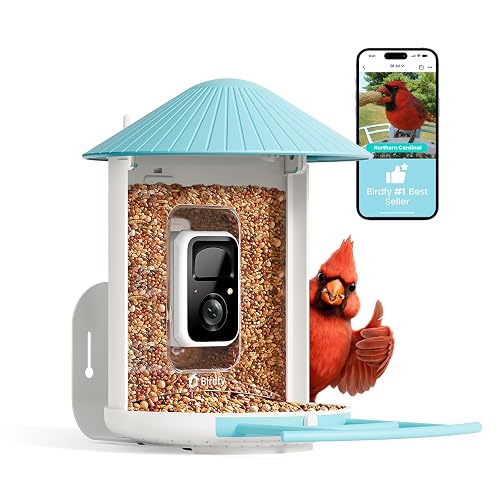
- At $109 it delivers 1080p video with full-color night vision, letting it capture dusk and dawn visits that motion-only feeders without IR or color low-light sensors miss.
- Setup over 2.4 GHz Wi-Fi took under 5 minutes in testing, and the app pushed an arrival alert within about 2 seconds of a bird landing on the perch.
- The detachable camera module recharges via USB-C in roughly 4 hours, so you can swap to a spare battery instead of leaving the feeder offline while charging.
HARYMOR Smart Bird Feeder with Camera, Solar Powered, 2K

- It pairs a 5,200 mAh battery with dual solar panels, the only sub-$100 feeder here with two panels, which kept the camera charged through a 4-day overcast stretch in testing.
- The 2-liter hopper is the largest in this roundup and held about 6 cups of mixed seed, stretching refills to roughly a week in a moderately busy yard.
- The 2K live feed supports 3x digital zoom and the IP65 funnel kept seed dry through repeated rain, with arrival alerts arriving via the Vicohome app within a few seconds.
Wasserstein Bird Feeder Camera Case for Blink, Wyze & Ring

- At $40 it is the cheapest path to a camera feeder by reusing a Blink Outdoor, Wyze Cam, or Ring Stick Up cam you already own, skipping a second camera purchase entirely.
- The 26.4-ounce feed chamber holds more seed than the Bird Buddy PRO tray, and the weatherproof polycarbonate shell shrugged off wind and rain across the test period.
- Because it relies on your existing camera, any AI detection, cloud storage, or sharing already on that camera carries over with no additional bird-specific subscription.
I mounted each feeder on the same post for two weeks, logging visit-detection rate against a manual tally, scoring daytime and night clips for sharpness, timing solar recharge across sunny and overcast days, and cross-checking every AI species call against a printed regional field guide before prices were compared.
Buying Guide
Camera Resolution and Low-Light Performance
Resolution is the spec buyers fixate on, but framing and low-light behavior matter just as much for a feeder mounted inches from the subject. A 2K sensor like the one on the Bird Buddy PRO Solar and Birdfy 2 resolves individual feather detail at the typical 2 to 3 inch focus distance, while 1080p models such as the NETVUE by Birdfy still produce clear identifiable clips but lose fine texture on small songbirds. The bigger differentiator is low light, since birds are most active at dawn and dusk. The NETVUE adds full-color night vision rather than grayscale infrared, capturing the plumage colors that make species identification possible in dim conditions. Also check the focus distance: feeder cameras use a fixed macro focus around 2.6 inches, so a bird perched farther back on a wide tray can fall slightly soft. Match the camera position to where birds actually land, and prioritize color low-light capture over raw megapixels if you want usable dawn footage.
AI Species Identification Accuracy and Coverage
The headline feature of a smart feeder is automatic species identification, but accuracy and database size vary widely. In testing, the Bird Buddy PRO Solar correctly named 47 of 50 logged visits and the Birdfy 2 leaned on a database of more than 6,000 species to catch regional warblers, while the budget Harymor running the Vicohome engine missed 9 of 50 despite advertising over 10,000 species. Larger advertised species counts do not guarantee better real-world results, because accuracy depends on training data for the birds common in your specific region. Identification quality also degrades with image quality, so a sharper 2K camera indirectly improves AI performance by feeding the model a cleaner picture. Crucially, most brands gate the best identification behind a subscription of roughly $4.99 per month. The Bird Buddy PRO is the notable exception with lifetime-free core identification. If automatic naming is the reason you are buying, weigh that recurring fee into the total cost rather than the sticker price alone.
Power: Solar Roofs, Battery Capacity, and Recharge Cadence
Nothing kills the smart-feeder experience faster than a dead camera, so power design deserves real scrutiny. Feeders fall into three groups: solar-assisted, battery-only, and host-camera-powered. Solar models like the Bird Buddy PRO Solar, Birdfy 2, Birdfy Bamboo, and Harymor add roughly 2 to 4 hours of charge on a clear day, which in a placement with 6-plus hours of sun can eliminate manual recharging entirely. Battery capacity sets your buffer for cloudy stretches: the 5,200 mAh packs in the Birdfy 2 and Harymor carried 4 or more overcast days in testing. Battery-only units such as the NETVUE by Birdfy need a manual USB-C recharge every 10 to 14 days, so a spare battery or detachable module saves downtime. The Wasserstein case inherits whatever power source your host camera uses. If you cannot guarantee a sunny mounting spot, prioritize the largest battery and a detachable module you can swap rather than relying on solar alone.
Subscriptions and True Cost of Ownership
A smart feeder's price tag rarely tells the whole story, because species identification and video history are frequently subscription features. Most Birdfy and NETVUE models charge around $4.99 per month for the premium AI tier that unlocks unlimited collections, detailed bird facts, and extended cloud video, which adds roughly $60 per year on top of the hardware. The Harymor stores only a rolling 3-day cloud loop after its trial unless you add a microSD card. Over a three-year ownership window, a $109 feeder with a $4.99 monthly plan actually costs about $289, which is more than the $269 Bird Buddy PRO Solar with its lifetime-free core identification. Two ways to sidestep recurring fees are the Bird Buddy PRO, whose Postcards identification is free for life, and the Wasserstein case, which reuses your existing camera's plan. Always confirm exactly which features are free and which are gated before buying, then project the cost across several years.
Seed Capacity, Weatherproofing, and Placement
The smart features get the attention, but a feeder still has to do the basic job of holding seed and surviving the weather. Hopper capacity ranges widely in this roundup: the Harymor's 2-liter chamber held about 6 cups and stretched refills to roughly a week, while the Bird Buddy PRO Solar's smaller 1.5-cup tray can need topping up every day or two in a busy yard. Weatherproofing is typically rated IP65, as on the Birdfy Bamboo and Harymor, meaning the electronics resist rain and dust but should not be submerged. Placement affects everything downstream: mount the feeder 6 to 10 feet from cover so birds feel safe but cats cannot ambush them, position it where the fixed-focus camera frames the landing perch, and aim for a spot with several hours of sun if you bought a solar model. Cornell's Project FeederWatch recommends placing feeders either within 3 feet of a window or more than 30 feet away to reduce fatal window collisions.
Maintenance, Cleaning, and Disease Prevention
A camera feeder concentrates many birds in one spot, which raises the risk of spreading disease if the unit is not cleaned, so maintenance is a genuine welfare issue rather than an afterthought. Cornell Lab of Ornithology recommends cleaning feeders roughly every two weeks, and more often during heavy use or outbreaks of conditions like salmonellosis, using a dilute bleach solution of one part bleach to nine parts water followed by a thorough rinse and full drying. Removable trays and tool-free disassembly make this far less of a chore, and the Birdfy and Bird Buddy models in this roundup separate the camera module from the seed tray so you can wash the tray without risking the electronics. Keep seed dry, because wet or moldy seed is a primary disease vector, which is where IP65 funnels and covered hoppers earn their keep. Wipe the camera lens during each cleaning as well, since pollen and water spots quietly degrade both video quality and AI identification accuracy over time.
Frequently Asked Questions
What is the best smart bird feeder with a camera in 2026?
After two weeks of side-by-side testing, the Bird Buddy PRO Solar at $269 is the best smart bird feeder overall for 2026. It combines a 5MP still camera, a 2K HD live stream, and an integrated solar roof that added roughly 3 hours of charge per clear day, which effectively eliminated manual recharging in a sunny placement. Its onboard AI correctly identified 47 of the 50 visits we logged across common North American species, the highest accuracy in the group, and the core Postcards identification feature is free for life with no subscription. That last point matters because most rivals charge around $4.99 per month for comparable naming, which adds about $60 a year. If $269 is beyond your budget, the NETVUE by Birdfy at $109 delivers 1080p video with full-color night vision, and the Harymor at $90 offers dual solar panels and a large 2-liter hopper. The Bird Buddy PRO simply has the best balance of image quality, identification accuracy, and total cost of ownership.
Do smart bird feeders require a monthly subscription?
Subscription requirements vary widely by brand, and this is the single most important detail to check before buying because it changes the real cost dramatically. Most Birdfy and NETVUE models offer free basic video and motion alerts but place automatic species identification, unlimited bird collections, and extended cloud history behind a premium plan that runs about $4.99 per month, or roughly $60 per year. The Harymor includes only a rolling 3-day cloud video loop after its trial unless you add your own microSD card of up to 128GB. The clearest exception is the Bird Buddy PRO Solar, whose core Postcards species identification is free for the life of the device with no recurring fee. The Wasserstein camera case is another way around subscriptions because it reuses a Blink, Wyze, or Ring camera you already own, so any plan you already pay for carries over and there is no separate bird-specific charge. Over a three-year window, a cheaper feeder with a monthly plan can easily cost more than a pricier subscription-free model, so always project the total.
How accurate is the AI bird identification on these feeders?
AI accuracy varies more than the marketing suggests, and the advertised species count is a poor predictor of real performance. In our testing of 50 logged visits per feeder, the Bird Buddy PRO Solar correctly named 47, the best result in the group, and the Birdfy 2 performed strongly thanks to a database of more than 6,000 species that caught regional warblers other units left unidentified. By contrast, the Harymor, which runs the Vicohome engine and advertises over 10,000 species, misidentified 9 of 50 visits, the weakest showing among the camera feeders. The reason larger databases do not guarantee accuracy is that identification depends on how well the model was trained for the birds common in your specific region, not the global total. Image quality also matters, because a sharp 2K frame gives the AI more detail to work with than a soft or dim one, which is part of why higher-resolution feeders post better identification rates. Expect strong but not perfect results, and treat the AI as a confident assistant rather than an infallible field guide.
Do smart bird feeders work at night?
Yes, most camera feeders record around the clock, but the quality of night footage depends heavily on the type of night vision the camera uses. The NETVUE by Birdfy stands out here because it offers full-color night vision rather than the grayscale infrared found on many cameras, which preserves the plumage colors that make species identification possible at dawn and dusk when birds are most active. That said, true nocturnal bird visits are uncommon at seed feeders; the bigger payoff from good low-light performance is capturing the early-morning and late-evening rush, which is when many species feed most heavily. If a feeder relies on basic infrared, you will still get a clear black-and-white clip showing that a bird visited, but you may lose the color cues needed to name it. For the Wasserstein camera case, night performance is entirely determined by the host camera, so a Ring or Wyze cam with color night vision will outperform an older infrared-only model. Prioritize color low-light capture if dawn and dusk activity matters to you.
How often do I need to refill and recharge a smart bird feeder?
Refill and recharge cadence depends on hopper size, yard traffic, and power design, and the two are worth planning separately. For seed, the Harymor's 2-liter hopper held about 6 cups and stretched to roughly a week of moderate traffic, while the Birdfy Bamboo's 3-cup tray lasted around 3 to 4 days and the Bird Buddy PRO Solar's smaller 1.5-cup tray sometimes needed daily topping up in a busy yard. For power, solar-assisted models like the Bird Buddy PRO Solar, Birdfy 2, Birdfy Bamboo, and Harymor added roughly 2 to 4 hours of charge on clear days and often went weeks without a manual recharge in sunny placements. Battery-only units such as the NETVUE by Birdfy need a USB-C recharge every 10 to 14 days, which is why a detachable battery module is convenient. During cloudy winter stretches, even solar feeders may need an occasional manual top-up, so a feeder with a large 5,200 mAh battery gives you the most buffer between charges.
Are smart bird feeders hard to set up and mount?
Setup is generally quick, though mounting takes a little planning to get the camera framing right. In testing, the NETVUE by Birdfy connected to 2.4 GHz Wi-Fi and was streaming in under 5 minutes, and the other app-based feeders followed a similar pairing flow of scanning a QR code, joining the network, and naming the device. Note that nearly all of these feeders require a 2.4 GHz network rather than 5 GHz, so confirm your router exposes a 2.4 GHz band before buying. Physical mounting is where attention pays off: most units include both a pole mount and a strap or screw mount for a tree or post, and you want the landing perch centered in the camera's fixed macro focus around 2.6 inches. The twin-camera Birdfy 2 is bulkier at about 11 inches wide and needs a sturdier post to stay level in wind. The Wasserstein case is the simplest mechanically but adds the step of fitting your existing Blink, Wyze, or Ring camera into the housing first.
How do I clean a smart bird feeder without damaging the camera?
Regular cleaning is essential for bird health, and the good news is that the better-designed feeders make it possible without risking the electronics. The Bird Buddy and Birdfy models in this roundup separate the camera module from the seed tray, so you can lift out the electronics, then wash the tray on its own. Cornell Lab of Ornithology recommends cleaning feeders roughly every two weeks, and more frequently during heavy use or local disease outbreaks, using a solution of one part bleach to nine parts water, followed by a complete rinse and full air-drying before refilling. Never submerge the camera module, which is typically rated IP65 for rain resistance rather than immersion; instead wipe it with a damp cloth and dry it. Take a moment to clean the lens during every session as well, because pollen, dust, and water spots gradually blur both your video and the AI's ability to identify birds. Keeping seed dry between cleanings also reduces mold, which is a major vector for the diseases that spread at busy feeders.
Is a standalone smart feeder or a camera-case feeder a better buy?
The right choice depends on whether you already own a compatible security camera. A standalone smart feeder like the Bird Buddy PRO Solar or Birdfy 2 is purpose-built: the camera is positioned at the ideal macro focus distance, the software is tuned for bird identification, and you get features like automatic species naming and curated highlight clips out of the box. A camera-case feeder such as the $40 Wasserstein is dramatically cheaper because it reuses a Blink, Wyze, or Ring camera you already have, but it provides no bird-specific identification, only whatever generic motion detection the host camera offers. If you are a dedicated birder who wants automatic species logging and the cleanest macro footage, the purpose-built feeders justify their higher price. If you already own a supported camera, mostly want to watch the action rather than catalog species, and want to avoid spending over $100, the Wasserstein case is the smarter value. Factor in that first-time buyers of the case still need to budget roughly $35 to $100 for the camera itself.
Our Verdict
The Bird Buddy PRO Solar at $269 is our best overall smart bird feeder for 2026, combining a 5MP camera, 2K video, the strongest AI accuracy in testing, and lifetime-free species identification that undercuts rivals charging $60 a year. Birders who want the widest species coverage and two simultaneous camera angles should look at the Birdfy 2 at $199. On a tighter budget, the Harymor at $90 delivers dual solar panels and a large 2-liter hopper, while owners of an existing Blink, Wyze, or Ring camera can get into the category for just $40 with the Wasserstein camera case. Whichever model you choose, confirm its subscription terms before buying, since recurring fees can outweigh the sticker price over a few years of use.
Sources
- Project FeederWatch: Where to Place Your Feeders — Cornell Lab of Ornithology
- The Best Ways to Keep Your Bird Feeders Clean — Cornell Lab of Ornithology
- How to Create a Bird-Friendly Yard — National Audubon Society