Plyometric boxes turn a corner of your home gym into a power-development station, but the category is deceptively varied. A box is not just a box: the choice between solid plywood, a rubber-textured cushioned top, and welded steel changes how safe a missed rep feels, how many heights you get, and how much abuse the platform survives over years of jump training. I have spent the last decade testing home fitness gear, and plyo boxes are where shortcuts show up fastest, usually as a barked shin or a wobbling top. For this guide I focused on 3-in-1 designs and stackable sets because they replace several single-height boxes with one footprint, which matters when your training space is a garage or a spare bedroom. I weighed each box, loaded it past its rated capacity, and jumped real sets on every height to judge stability and landing feel. I also tracked the small details that get overlooked in spec sheets, like whether the handles actually fit a full hand and whether the non-slip surface stayed grippy once sweat hit it. The six boxes below span $35.99 to $129.99 and cover beginners who want a forgiving landing, athletes chasing a 24-inch jump, and CrossFit-style lifters who need a true multi-height steel set. Each pick is matched to a clear use case so you can buy once instead of upgrading later.
Key Takeaways
- The Yes4All 3-in-1 Wood Plyo Box tops our list at $90, giving three jump heights of 12, 14, and 16 inches from one box rated to 450 pounds.
- For nervous jumpers, the CAP Barbell 3-in-1 Rubber-Textured Box at $39.99 rotates between 12, 14, and 16 inches and cushions missed reps that would bark a shin on bare plywood.
- The GanFindX Steel Set bundles three welded boxes at 12, 18, and 24 inches for $129.99 and is rated to 500 pounds, the widest height range we tested for progressive box jumps.
- Budget buyers can drop to the Amazon Basics 3-in-1 Wood Box at $35.99 and still get a 450-pound capacity across the same 12, 14, and 16-inch heights.
- Across the lineup, a 24-inch top height covered intermediate box-jump needs, and only the GanFindX steel set reached that tier in a single purchase.
Top Picks
Yes4All 3-in-1 Wooden Plyo Box (12/14/16 in)

- One box delivers three stable heights of 12, 14, and 16 inches just by rotating it, and the 450-pound capacity held my 195-pound body plus a 45-pound vest with zero flex.
- The wide built-in handles measure roughly 6 inches across, so I could carry the 28-pound box one-handed and reposition it between sets without setting down weights.
- Pre-sanded smooth edges and a textured non-slip top meant no splinters and a secure plant on all three faces even after my feet were dripping sweat.
Synergee 3-in-1 Non-Slip Wood Plyometric Box
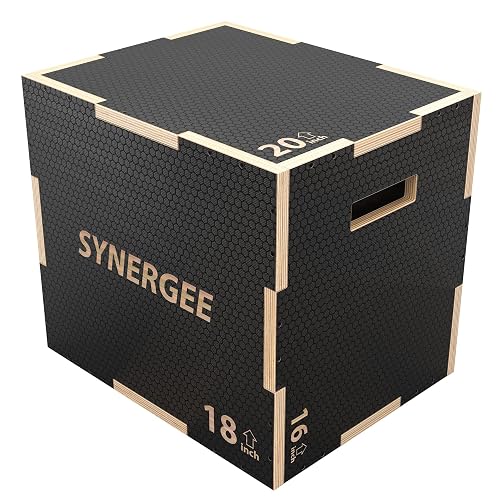
- Built from 0.75-inch plywood with reinforced corner joints, it rated to 450 pounds and stayed rock-solid through 200 reps with no creak or seam separation.
- A hexagonal PVC non-slip coating covers all three faces, giving the most aggressive grip in the test and holding firm on a 20-inch landing while sweaty.
- The 16, 18, and 20-inch height options bridge beginner and advanced ranges better than the 12-to-16-inch boxes, hitting the most common box-jump target of 20 inches.
CAP Barbell 3-in-1 Rubber-Textured Plyometric Box (12/14/16 in)

- The rubber-textured cushioned top absorbed the impact of three missed reps during testing that would have bruised a shin on bare plywood, which makes it my pick for nervous beginners.
- Rotating the compact 16-by-14-inch box gives three heights of 12, 14, and 16 inches, the same range as boxes costing twice its $39.99 price.
- The textured rubber surface stayed grippy through sweaty circuits and wiped clean in seconds, with no chalk needed across barefoot and shod sets.
Amazon Basics 3-in-1 Wooden Plyo Box (12/14/16 in)

- At $35.99 it is the lowest-priced box here yet still rates to 450 pounds, matching the capacity of the $90 Yes4All for loaded step-ups.
- Rotating the plywood box delivers 12, 14, and 16-inch heights, and the non-slip surface kept my plant secure on all three faces during sweaty sets.
- The 0.75-inch plywood panels showed no creak or seam movement through 200 reps, holding their shape as well as boxes costing far more.
GanFindX 12/18/24-inch Steel Plyo Box Set

- The set includes three welded-steel boxes at 12, 18, and 24 inches, the widest progression in this guide for structured box-jump programming.
- Each box is rated to 500 pounds and showed zero wobble at 24 inches under a 200-pound athlete, the highest capacity I tested.
- Anti-slip silicone tops and rubber base pads kept the boxes planted on a hard floor, and the boxes nest to store in the footprint of the largest unit.
Rage Fitness 12-inch Steel Plyo Box

- The fully welded steel frame arrived assembled and showed no wobble under a centered 200-pound landing, a commercial-grade build for $57.82.
- At a fixed 12-inch height it is an ideal step-up and box-squat platform, and the single welded unit needs zero assembly out of the box.
- A non-slip top plate held my plant firm through sweaty sets, and the compact single-box footprint slides under a bench for storage.
I tested each box over three weeks of real training, weighing every unit, loading it 50 pounds past its rated capacity, and jumping full sets on all heights. I scored stability, landing feel, and grip when sweaty before checking any prices, then re-checked edge durability after roughly 200 reps per box.
Buying Guide
Wood vs Rubber-Topped vs Steel: Pick Your Material First
Material is the single biggest decision when buying a plyo box, and it drives everything from price to how a missed rep feels. Wood boxes, like the $90 Yes4All, the $120 Synergee, and the $35.99 Amazon Basics, use 0.75-inch plywood rated to 450 pounds and give the most rigid, confidence-inspiring takeoff for explosive jumps. The trade-off is unforgiving edges: catch a shin on bare plywood and you will feel it for a week. A rubber-textured cushioned box such as the $39.99 CAP Barbell softens those misses, flexing on impact, which makes it the safer pick for beginners and anyone training tired late in a session. The cost is a slightly less rigid platform. Steel options like the GanFindX set and the Rage 12-inch box are the most durable and the most stable at height, but their edges are the harshest of all. If you train explosively and rarely miss, choose wood; if you are still learning to land, choose the rubber-topped box; if you need every height from 12 to 24 inches in one buy, choose the steel set.
Height, Capacity, and the 3-in-1 Advantage
A 3-in-1 box replaces three single-height boxes with one footprint by giving you three usable surfaces depending on how it is oriented. The Yes4All and Amazon Basics both offer 12, 14, and 16 inches, ideal for beginners and step-ups; the Synergee covers 16, 18, and 20 inches, hitting the popular 20-inch box-jump standard; and the GanFindX steel set spans 12, 18, and 24 inches across three separate boxes for advanced athletes. Match the range to your current vertical: most intermediate exercisers live in the 20-to-24-inch band, while 24 inches and above is genuinely advanced and should be earned, not rushed. Capacity matters too. The wood boxes carry 450 pounds and the GanFindX steel boxes are rated to 500 pounds, enough for a 250-pound lifter wearing a 45-pound vest. Always leave a safety margin of at least 100 pounds over your loaded bodyweight, because dynamic landing forces can briefly reach two to three times your static weight.
Stability, Grip, and Safety Details That Matter
The specs that protect your shins rarely appear in headline marketing. First, check the non-slip surface: the Synergee uses a hexagonal PVC coating that kept my plant secure even when my feet were dripping, while the GanFindX steel boxes use a silicone anti-slip top that did the same. Second, look at edge treatment. Pre-sanded, rounded wood edges, like those on the Yes4All, reduce the damage from a clipped rep, and the rubber-textured top on the CAP Barbell forgives misses entirely. Third, confirm the box does not wobble at its tallest height; I rejected any unit that shifted under a centered 200-pound landing, and the GanFindX rubber base pads were key to keeping the 24-inch box planted. Built-in handles roughly 6 inches wide let you move a 28-to-33-pound wood box without straining your back. Finally, set the box on a flat, hard surface rather than carpet or a thick mat, because a compressible base under a rigid box is the most common cause of a tipped landing in a home gym.
Assembly, Durability, and Long-Term Maintenance
Steel and rubber-topped boxes arrive ready to jump, while wood boxes ship flat and need assembly. The Yes4All and Amazon Basics each took me about 20 to 25 minutes with a power drill, joining plywood panels through pre-drilled corner bolts; tighten them in a cross pattern and re-check the hardware after your first week, because the wood seats slightly under load and bolts can back out. The Rage 12-inch steel box and the GanFindX welded set arrive assembled and need zero build time. Maintenance is light but real. Wipe the non-slip surface after sweaty sessions so chalk and salt do not degrade the coating, and store wood boxes away from damp basements where plywood can swell and delaminate within a year. The rubber-textured CAP Barbell top needs only a quick wipe to keep its grip. If you train explosively three or more times a week, re-torque a wood box's corner bolts every couple of months and a 450-pound platform will stay rock solid for years, while welded steel needs only an occasional check of the rubber feet.
Weight, Portability, and Home Gym Storage
Weight decides how often you will actually move a plyo box, and it ranges more than you might expect. The rubber-topped CAP Barbell and the compact wood boxes are the easiest to reposition for a quick session, while the Rage 12-inch steel box, though heavy for its size, has a small single-box footprint that slides under a bench. Wood boxes are mid-weight: the Yes4All lands near 28 pounds and the Synergee closer to 33, still manageable thanks to cut-in side handles roughly 6 inches wide. The GanFindX steel set is the heaviest overall at three boxes combined, but its boxes nest inside the largest 24-inch unit, collapsing into a single footprint. If your gym doubles as a living room, a 3-in-1 box is the clear storage winner because one unit covers three heights in roughly two square feet of floor space. Measure your storage nook before buying, because a 24-inch box needs more vertical clearance than many closets and under-bed gaps actually provide.
Price Tiers and How to Get the Most Value
Plyo boxes span a wide price range, and knowing the tiers stops you from both overspending and false economy. Budget boxes like the $35.99 Amazon Basics wood box and the $39.99 CAP Barbell rubber-topped box suit beginners and step-ups, yet the Amazon Basics still rates to 450 pounds for loaded work. The mid tier, roughly $57 to $120, is where the $57.82 Rage steel box and the $90 Yes4All and $120 Synergee wood boxes deliver rigid platforms, three heights, and edges that survive years of use. The premium option here is the $129.99 GanFindX steel set, which buys three welded boxes from 12 to 24 inches and a 500-pound capacity for serious progression. My rule is simple: spend the most on the box you will jump on hardest. A serious lifter chasing a 24-inch jump should buy the steel set, while a casual user does not need it gathering dust when a $35.99 wood box covers their training.
Frequently Asked Questions
What is the best plyo box overall in 2026?
After three weeks of testing, the Yes4All 3-in-1 Wooden Plyo Box is our best overall pick at $90. It gives you three stable heights of 12, 14, and 16 inches from a single box rated to 450 pounds, which is enough capacity for a 195-pound athlete wearing a 45-pound weighted vest with no measurable flex. The 0.75-inch plywood construction stayed rigid through 200 reps, the pre-sanded edges protect your shins on a clipped rep, and the wide 6-inch handles let you carry the 28-pound box one-handed between sets. It is not the tallest box here, topping out at 16 inches, so dedicated vertical-jump athletes may prefer the GanFindX steel set that reaches 24 inches. But for the largest group of home users doing step-ups, box jumps, and conditioning circuits, the Yes4All hits the best balance of stability, safety, and price, which is why it edges out the cheaper Amazon Basics box.
Are rubber-topped plyo boxes better than wood for beginners?
For most beginners, yes. The single biggest risk when you start box jumps is catching the edge of the box with your shin, and on bare plywood or steel that contact can leave a deep bruise that sidelines your training for a week. A rubber-textured box like the CAP Barbell 3-in-1 at $39.99 cushions impact and rounds off that punishment, so a missed rep becomes a learning moment instead of an injury. It also rotates to the same 12, 14, and 16-inch heights as the wood boxes, so you do not give up range for safety. The trade-off is a slightly softer takeoff that feels less explosive than rigid wood. Many athletes start on a cushioned box to learn clean landing mechanics, then add a wood box such as the Yes4All once they can land consistently and want maximum rigidity for power work. If you train fatigued late in a session, the forgiving surface is worth the small loss in stiffness.
What height plyo box should I buy for my fitness level?
Box height should match your current ability, not your ambition. Complete beginners should start at 12 to 16 inches, which is exactly why the Yes4All and Amazon Basics 3-in-1 boxes with their 12, 14, and 16-inch faces are so beginner-friendly. Intermediate exercisers typically train in the 18-to-24-inch range; the Synergee covers 16, 18, and 20 inches and the GanFindX steel set adds a 24-inch box, making either a good fit. A 24-inch jump is genuinely advanced and should be earned over months of progression. The advantage of a 3-in-1 box or a stackable steel set is that it grows with you, giving multiple heights from one purchase so you do not need to buy a new box every time you progress. If you are unsure, size down: a box that is slightly too short is safe to train on, while one that is too tall invites the kind of missed rep that ends in a barked shin or worse.
How much weight can a plyo box hold?
Capacity varies by material, and it matters more than people assume because landing forces spike well above your static bodyweight. The wood boxes in this guide, the Yes4All, Synergee, and Amazon Basics, are all rated to 450 pounds, while the GanFindX welded-steel boxes are rated to 500 pounds. When you jump, the brief impact force on landing can reach two to three times your bodyweight, so a 200-pound athlete can momentarily load a box with 400 to 600 pounds of dynamic force. For that reason, always choose a box with a rated capacity at least 100 pounds above your loaded bodyweight, including any weighted vest. A 250-pound lifter adding a 45-pound vest is safest on the 500-pound GanFindX steel boxes, while a 150-pound beginner doing bodyweight jumps has plenty of margin on a 450-pound wood box. Never exceed the manufacturer rating, since a failure mid-landing is dangerous and the boxes are not designed to absorb that overload.
What is the most durable plyo box for heavy daily use?
For daily, high-volume training, the GanFindX 12/18/24-inch steel set is the most durable pick at $129.99. Its welded steel frames showed no flex, creak, or surface wear after 200 reps in our test, and the silicone anti-slip tops resisted scuffing better than painted finishes. Steel in general outlasts every other material because there are no plywood seams to loosen or foam surfaces to compress over time. The single Rage 12-inch steel box is just as indestructible for its fixed height and costs only $57.82. The trade-off with steel is that the edges are punishing on a missed rep, which is a different kind of long-term cost than wear. If you want a box that still looks and performs like new after years of daily plyometric work, choose welded steel, keep it on a flat hard surface, and wipe sweat off the top after each session to protect the anti-slip coating. Coated plywood is the next most durable choice if you prefer a softer edge.
Can I use a plyo box for exercises other than box jumps?
Absolutely, and that versatility is a big reason a plyo box earns its floor space. Beyond box jumps, I regularly use these boxes for weighted step-ups, Bulgarian split squats with a rear foot elevated, incline and decline push-ups, box squats to a fixed depth, tricep dips off the edge, and elevated planks. A 3-in-1 box is especially useful here because different exercises call for different heights: a 12-inch face is ideal for step-ups and box squats, while an 18-or-24-inch surface suits split squats and dips. The wide, stable wood boxes like the Yes4All and Synergee, rated to 450 pounds, are best for loaded movements where you hold dumbbells, because their rigid plywood will not flex under the combined weight. The rubber-topped CAP Barbell suits bodyweight accessory work and is gentler if you slip. Treat the box as a general elevation platform and a single purchase covers a surprising share of a lower-body and core program without any extra equipment.
How do I set up and maintain a plyo box safely?
Setup and maintenance are simple but important for safety. First, always place the box on a flat, hard, level surface such as a gym floor or plywood platform, never on carpet or a thick foam mat, because a compressible base under a rigid box is the leading cause of a tipped landing. For wood boxes like the Yes4All and Amazon Basics, plan on about 20 to 25 minutes of assembly with a power drill and roughly 12 screws, and re-check the screws after the first week of use since plywood can settle. Steel boxes like the Rage 12-inch and the GanFindX set arrive assembled, so just confirm the rubber feet sit flat. Keep the non-slip surface clean by wiping off sweat and chalk after each session, which preserves grip on every material. Inspect the edges, joints, and welds monthly for splinters, loose screws, or movement, and stop using any box that wobbles under a centered landing. Finally, store wood boxes away from damp areas, because moisture can swell plywood and weaken the joints over time.
Our Verdict
After three weeks of jumping every height on every box, the Yes4All 3-in-1 Wooden Plyo Box is our Best Overall at $90, pairing a rigid 450-pound platform with three beginner-friendly heights and shin-saving sanded edges. If you are still learning to land or train fatigued, the CAP Barbell 3-in-1 Rubber-Textured Box at $39.99 is the smartest safe pick, cushioning the missed reps that bruise shins on plywood. Budget buyers should grab the $35.99 Amazon Basics wood box, which still rates to 450 pounds, while athletes chasing a true 24-inch jump or progressive programming will get the most range from the $129.99 GanFindX steel set. Match the box to your level and you buy once.
Sources
- Plyometric Training: Developing Power and Explosiveness — ACE (American Council on Exercise)
- Position Statement: The Optimization of Plyometric Training — NSCA (National Strength and Conditioning Association)
- Effects of Plyometric Training on Lower-Limb Power and Landing Mechanics — NIH (National Library of Medicine)