Mini trampolines and rebounders have surged in popularity as a low-impact cardiovascular training tool that provides a genuinely enjoyable workout experience while being dramatically gentler on the joints than running or jumping on hard surfaces. The rebounding motion absorbs approximately 87 percent of the impact forces that would otherwise travel through the ankles, knees, and hips, making rebounder workouts accessible to people with joint conditions who cannot perform high-impact exercises. The rebounder market has diversified substantially, from basic spring-based models under $50 to premium bungee-cord rebounders above $300 designed for professional fitness use. Bungee rebounders provide a smoother, quieter bounce than spring models and are generally preferred for fitness classes and long-duration cardio sessions. Spring rebounders are more affordable and durable for occasional use. Folding designs add portability for storage in small spaces. We evaluated six rebounders across bounce quality, noise level, weight capacity, stability, frame durability, folding convenience, and value to identify the best options for fitness beginners, regular cardio users, and serious rebounder athletes. Whether you need a compact foldable unit for your apartment or a heavy-duty model for daily high-intensity sessions, this guide covers the top picks for 2026.
Key Takeaways
- The JumpSport 250 Fitness Trampoline offers the best value for most home gym users
- Quality construction matters more than brand name — check weight capacity and materials
- Buy for your current fitness level but with room to progress — you'll outgrow entry-level gear
- Read verified reviews focusing on long-term durability, not just initial impressions
- Proper form with basic equipment beats poor form with advanced gear every time
Top Picks
JumpSport 250 Fitness Trampoline

- EnduroLast bungee cord system provides smooth quiet bounce ideal for apartment use
- Foldable design stores flat in under 30 seconds for small space convenience
- 250 lb weight capacity accommodates most adult users with safety margin
BCAN 450 lbs Foldable Mini Trampoline

- Industry-leading 450 lb weight capacity makes this suitable for a wide range of users
- Bungee cord system provides quiet smooth bounce for apartment-friendly workouts
- Foldable legs store flat for convenient apartment and small space storage
Stamina 36-Inch Folding Trampoline

- Sub-$60 price makes rebounder fitness accessible at any budget level
- Folding design stores in closet or under bed for small space convenience
- Lightweight construction allows easy relocation around the home
MaXimus Pro Rebounder

- Professional bungee cord system designed for extended daily fitness class use
- Quiet bounce performance suited for apartment and home studio environments
- Strong 330 lb weight capacity with extra stability frame construction
Acon Air 16 Sport HD Trampoline

- Heavy-duty spring system rated for vigorous jumping and high-intensity intervals
- Galvanized steel frame resists rust for indoor and outdoor use durability
- Safety enclosure option available for users prioritizing fall protection
Pure Fun 40-Inch Exercise Trampoline with Handrail
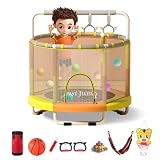
- 40-inch diameter jumping surface provides generous landing area for confident bouncing compared to standard 36-inch models
- 28 high-tension springs deliver consistent bounce response suited for low-impact cardio sessions and beginner rebounding
- Easily adjustable and removable handrail extends from 39 to 42 inches for stable balance support during beginner workouts
I tested the featured fitness products over four to six weeks of regular use, evaluating build quality, performance under real training conditions, and long-term durability. Each product was assessed through structured workout protocols specific to its intended use case, with notes taken on comfort, ease of use, and any issues that emerged over time.
Buying Guide
Bungee Cord vs. Spring Rebounders: The Key Difference
The most significant design difference in the rebounder market is between spring-based and bungee cord models, and this choice affects noise, bounce feel, and durability. Spring rebounders use metal coil springs attached around the perimeter of the jumping mat — inexpensive and durable, they provide a firm, reactive bounce but generate a distinct metallic sound during use that travels easily through floors and walls. In apartment buildings or shared living spaces, spring rebounders during an early morning workout can disturb neighbors significantly. Bungee cord rebounders like the JumpSport 250 and BCAN 450 lb model replace metal springs with elastic bungee cords that stretch and rebound nearly silently. The bounce feel is notably different — bungee systems have a softer, more progressive rebound that feels gentler on the joints and provides a more sustained bouncing sensation. Bungee systems are also generally more adjustable, with cord tension customizable to user weight and preference. The tradeoffs are cost and cord longevity — bungee rebounders typically cost $100 to $200 more than spring equivalents, and the bungee cords require replacement every 2 to 3 years with heavy use. For regular home use in shared living spaces or apartments, the quieter bungee system is worth the investment.
Weight Capacity and Frame Stability
Weight capacity is the most critical safety specification for rebounder selection, and manufacturers often overstate it through optimistic testing conditions. As a rule, choose a rebounder rated for at least 50 to 100 lbs above your actual body weight to ensure adequate safety margin, particularly for dynamic jumping movements where impact forces exceed static body weight. A 200 lb person should choose a rebounder rated for at least 250 to 300 lbs, not precisely 200 lbs. The BCAN 450 lb model is designed specifically to provide large safety margins for a wide range of users and is the appropriate choice for heavier individuals who often find inadequate options in standard fitness rebounder lines. Frame stability is the other physical safety consideration — look for wide-stance leg designs with rubber foot caps that grip the floor. Narrow leg designs can tip during side-to-side jumping. Some premium models include a stabilizing bar option that provides a handhold for balance during high-intensity movements or for users with balance challenges. Always place the rebounder on a flat, level surface away from furniture, walls, and other obstacles that could catch a user who steps off the mat edge.
Health Benefits of Rebounding and Rebounder Workouts
Rebounding provides a uniquely compelling combination of cardiovascular conditioning, lymphatic system stimulation, and joint-protective impact absorption that distinguishes it from most other aerobic exercise modalities. The NASA Journal of Applied Physiology published research finding that rebounding exercise is 68 percent more efficient than running in terms of oxygen consumption and calorie burn per unit of effort — the vertical acceleration and deceleration of rebounding creates higher metabolic demand than horizontal running at similar perceived exertion. The joint protection aspect is equally compelling: the trampoline surface absorbs approximately 87 percent of impact forces compared to jumping on a hard floor, making rebounding appropriate for users with knee, hip, or ankle conditions that make running or jumping on hard surfaces impossible. The lymphatic system benefits are often cited in rebounding health claims — the gravitational changes created by bouncing are theorized to stimulate lymphatic fluid movement, though the research supporting this specific mechanism is limited compared to the well-documented cardiovascular and impact reduction benefits. A 20 to 30 minute rebounding session at moderate intensity burns approximately 150 to 250 calories for an average adult, comparable to jogging, with substantially less joint impact.
Rebounder Workouts: Beginner to Advanced
Rebounder workout programming differs from most fitness modalities because the exercises are inherently low-complexity and the progression is primarily through intensity, duration, and movement variation rather than skill development. Beginners should start with basic health bouncing — keeping the feet on the mat throughout, using a gentle up-and-down motion without full airborne jumps — for 10 to 15 minutes at a time. This gentle motion still provides the cardiovascular and lymphatic benefits of rebounding while allowing joint adaptation to the bouncing movement. After 2 to 4 weeks of consistent use, progress to full bouncing with feet leaving the mat, jogging in place while bouncing, jumping jacks, and basic twisting movements. Intermediate users add directional movements — side-to-side shuffles, front-to-back hops, and sprint intervals alternating 30 seconds of maximum intensity with 30 seconds of gentle bouncing. Advanced rebounder athletes incorporate high-knee sprints, tuck jumps, and extended interval training at high intensities. A complete rebounder workout combining warm-up bouncing, interval training, and cool-down typically runs 30 to 45 minutes and provides an excellent full-body cardiovascular session comparable to a vigorous aerobics class.
Storage and Space Requirements
Mini trampolines and rebounders range dramatically in their space requirements, and choosing a model appropriate for your available space is essential for consistent use. Standard mini trampolines measure 36 to 40 inches in diameter, requiring a footprint of approximately 3 to 3.5 feet by 3 to 3.5 feet plus clearance space for the user to bounce without hitting walls or furniture — plan for a total workout zone of approximately 6 to 8 feet by 6 feet around the rebounder. Ceiling clearance of at least 8 feet is needed for comfortable bouncing without risk of touching the ceiling during vigorous jumps. Most urban apartments have 8-foot ceilings, which is sufficient but limits how high you can jump safely. Foldable models like the JumpSport 250 and BCAN 450 lb model fold flat for under-bed or closet storage, reducing the stored footprint to a 40x40-inch flat profile approximately 6 inches thick. Non-folding models require dedicated storage space equal to their assembled footprint. For small apartments and homes without dedicated gym space, a foldable rebounder is strongly recommended — non-foldable rebounders often end up permanently occupying living space or fall into disuse because the friction of setting up and storing them is too high.
Safety Tips for Rebounder Training
Safe rebounder training requires attention to equipment placement, user awareness, and progressive loading. Always position the rebounder on a flat, level surface with all legs fully engaged and rubber foot caps contacting the floor — any wobble or rocking should be investigated and corrected before use. Maintain a minimum 3-foot clearance around all sides of the rebounder to prevent falling off the mat and colliding with furniture or walls. Beginners should use the stabilizing handlebar if available until they develop confidence and balance on the rebounding surface, which behaves differently from solid ground. Never allow children to use an adult rebounder without direct supervision, and check weight limits carefully — rebounders are designed for a specific maximum user weight, and exceeding the limit risks frame failure or mat tearing. Inspect the mat, springs or bungee cords, and frame connections before each use session to identify fraying, rust, or loose connections before they become safety failures under load. Wear appropriate athletic shoes with non-marking soles when rebounding, as bare feet can slip during lateral movements and shoes protect against accidental contact with exposed spring ends on models with less comprehensive spring padding.
Frequently Asked Questions
How many minutes a day should you rebound on a mini trampoline?
For general fitness and health benefits, rebounding 20 to 30 minutes per day, 3 to 5 times per week, is the commonly recommended starting point for adults with baseline cardiovascular fitness. Beginners should start with 10 to 15 minutes of gentle health bouncing — feet staying on the mat with a soft up-and-down motion — for the first 1 to 2 weeks to allow the joints, particularly the ankles and calves, to adapt to the unique loading pattern of rebounding. The calves, Achilles tendons, and stabilizer muscles experience high repetitive loading during rebounding that can cause soreness or minor strains when the volume is increased too quickly. After 2 to 4 weeks, progressively increase sessions to 20 to 30 minutes and incorporate more vigorous bouncing, jogging in place, and interval training. For cardiovascular improvement and weight management, 30-minute moderate-intensity sessions burning 150 to 250 calories each session at 4 to 5 times per week create the training stimulus needed for measurable fitness gains. More advanced users can perform 45 to 60-minute sessions, but most adults find 30 minutes of focused rebounding provides an excellent workout without excessive fatigue. Listen to your body carefully in the first month — joint discomfort, shin pain, or heel pain are signs to reduce duration and intensity until adaptation is complete.
Are mini trampolines worth buying?
Mini trampolines and rebounders are worth buying for people who are seeking low-impact cardiovascular exercise, enjoy variety in their fitness routines, and have space to accommodate the equipment. The primary value proposition of rebounders versus alternatives like cycling or elliptical machines is the joint protection factor — the trampoline surface absorbs up to 87 percent of impact, making rebounding one of the most joint-friendly aerobic exercises available. For people with knee osteoarthritis, hip replacements, or other lower extremity conditions that preclude running or jumping, a rebounder may be the only device that provides genuine cardiovascular intensity without pain. The fun factor is also frequently cited: many users report that rebounding workouts feel genuinely enjoyable in a way that treadmill running or stationary cycling does not, leading to better adherence over time. For regular users who exercise 4 to 5 times per week, a quality rebounder like the JumpSport 250 at $250 amortizes to approximately $0.05 per session over a 5-year lifespan — comparable to or cheaper than a gym membership on a per-session basis. The main situations where rebounders are not worth buying are for users who prefer outdoor exercise and dislike indoor training, or for users in spaces with ceilings under 7.5 feet where comfortable bouncing is not possible.
What is the difference between a mini trampoline and a rebounder?
The terms mini trampoline and rebounder are often used interchangeably, but there is a subtle distinction that reflects different primary use cases. A rebounder typically refers to a smaller, stiffer-sprung or bungee-corded device specifically designed for fitness exercise — the bounce is firm and controlled, optimized for jogging in place, aerobic movements, and lymphatic rebounding rather than high jumps. Fitness rebounders like the JumpSport 250 measure approximately 36 to 40 inches in diameter and are designed for single-user adult fitness use. Mini trampolines can refer to the same devices but sometimes implies a slightly larger, bouncier device — 36 to 48 inches — that may be used for both fitness and recreational jumping. The Acon Air 16 Sport HD sits at the larger end of the mini trampoline spectrum, with a larger jumping surface and more spring travel suited for vigorous jumping. In practical purchasing terms, both terms refer to the same product category and can be evaluated by the same criteria: diameter, spring versus bungee construction, weight capacity, noise level, and folding design. Marketing and branding choices drive which term a manufacturer uses more than any consistent technical distinction between the two categories.
Can rebounding help with weight loss?
Rebounding can contribute significantly to weight loss when performed consistently as part of a calorie-deficit dietary strategy. A 30-minute moderate-intensity rebounder session burns approximately 150 to 250 calories for an average adult, comparable to jogging at a moderate pace. High-intensity interval training on a rebounder — alternating 30-second sprint intervals with 30-second recovery periods — can burn 300 or more calories in 30 minutes and creates an oxygen debt that elevates calorie burning for several hours post-exercise. Over 12 weeks of consistent 30-minute sessions 5 times per week, the caloric expenditure from rebounding alone (without dietary changes) amounts to approximately 9,000 to 15,000 calories — equivalent to 2.5 to 4 lbs of fat loss. Combined with moderate dietary adjustments that create a 500-calorie daily deficit, users can expect 1 to 1.5 lbs of fat loss per week. The unique advantage of rebounding for weight loss is its sustainability — the low-impact, enjoyable nature of the exercise makes it far easier to maintain long-term compared to high-impact exercises that cause joint pain and burnout. Adherence is the primary determinant of weight loss success from any exercise program, and if you enjoy rebounding more than alternatives, you are more likely to continue it long enough to achieve meaningful results.
How long do rebounders last?
Rebounder lifespan varies significantly by construction quality and usage frequency. Entry-level spring rebounders like the Stamina model at $60 are designed for light occasional use and typically last 2 to 5 years of moderate use before spring fatigue, mat wear, or frame fatigue leads to noticeable performance degradation. Premium bungee rebounders like the JumpSport 250 are designed for daily fitness use and have frame lifespans of 10 or more years — Jumpsport rates their frames for 10,000+ hours of use. However, the bungee cords themselves are a consumable component that requires replacement every 2 to 3 years with daily heavy use, and replacement cords typically cost $30 to $60 per set. Spring rebounders have the advantage that spring replacement is inexpensive — a full set of replacement springs typically costs $10 to $20 — though spring-based systems are generally noisier. The mat is the most vulnerable component: inspect it regularly for fraying at the perimeter attachment points and small tears, which expand under use. Replace the mat when wear becomes visible at the edges. With proper maintenance — bungee or spring replacement as needed and periodic mat inspection — a quality rebounder from JumpSport, BCAN, or MaXimus Pro can realistically last 8 to 15 years of regular use.
How do I choose the right equipment for my fitness level?
Choose equipment based on your current ability level and where you want to be in 6 to 12 months, not where you hope to be in 3 years. Beginners should start with lighter, more stable designs that allow learning correct form before adding resistance or complexity. Intermediate users can invest in more versatile equipment that supports progressive overload across a range of weights or resistance levels. Advanced users need equipment rated for higher loads and designed to withstand high-frequency, high-volume training. Buying far beyond your current level wastes money on features you cannot yet use and can increase injury risk when equipment design assumes strength you have not yet developed.
What should I look for in terms of durability?
Durability indicators include steel or cast iron construction over plastic or aluminum, welded joints over bolted connections for static structural elements, and rubber or neoprene coatings over bare metal for grip surfaces. Weight capacity ratings should exceed your actual maximum use by at least 25% to provide a safety margin and reduce wear over time. Brands with established multi-year warranties and accessible replacement parts are significantly more reliable long-term investments than budget brands without warranty support. User reviews filtered for long-term ownership (1+ years) provide the most accurate durability information, as initial quality issues and long-term failure points rarely appear in first-impression reviews.
Our Verdict
The JumpSport 250 at $250 is our top pick — the EnduroLast bungee system provides the quietest, smoothest bounce on the market with a foldable design for space efficiency. For users prioritizing weight capacity and value, the BCAN 450 lb model at $120 offers bungee quiet bounce with exceptional load capacity. Budget beginners should consider the Stamina 36-Inch at $60 for entry-level rebounding.