A good office chair only solves half of the lower-back problem. Most task chairs put a flat or shallow panel where your lumbar curve should be, and after a few hours of sitting your spine flattens into a slouch that loads the discs at the base of your back. A dedicated lumbar support pillow fills that gap, pushing the natural inward curve of the lower spine forward so your pelvis stays upright and your shoulders stack over your hips. We pulled together six memory-foam lumbar pillows that are in stock right now and cover every price point from $22.99 to $39.99. They range from the plush, best-selling Everlasting Comfort Original to the rigid, board-backed DMI Contoured pillow for people who want firm, structured support. In between sit multi-strap posture models from ComfiLife and QUTOOL, a four-zone cushion from Vekkia, and a no-frills budget pick from FORTEM. Every pillow here uses solid memory foam rather than shredded fill, ships with a removable washable cover, and secures to a chair with adjustable straps so it works on a desk chair, gaming chair, or car seat. Below we rank all six, explain who each one suits, and answer the setup and fit questions people ask most before buying.
Key Takeaways
- The Everlasting Comfort Original tops our list at $39.99 with high-density memory foam and dual straps that fit office and gaming chairs up to 32 inches wide.
- The FORTEM pillow is our budget pick at $22.99, undercutting the field while keeping a washable mesh cover and a 1-year warranty.
- The DMI Contoured pillow adds a rigid composite-board insert behind its 14 x 13 x 5-inch foam for the firmest, most structured support in the group.
- The ComfiLife Premium uses three adjustable straps instead of the usual two, so it holds position on tall executive and mid-back chairs.
- All six pillows weigh under 2 pounds and use removable, machine-washable covers, so switching one between an office chair and a car seat takes seconds.
Top Picks
Everlasting Comfort The Original Lumbar Support Pillow

- High-density memory foam holds its ergonomic curve through 8-plus-hour workdays without bottoming out or flattening.
- Dual adjustable straps with extension pieces secure the pillow to office and gaming chairs measuring up to 32 inches wide.
- The removable 3D mesh cover unzips for machine washing and keeps airflow moving against your lower back.
ComfiLife Premium Memory Foam Lumbar Support Pillow

- Three adjustable straps instead of the usual two keep the cushion fixed on tall executive and mid-back chairs.
- Heat-responsive memory foam softens within about 2 to 3 minutes of contact to mold to the curve of your lower spine.
- A dual-material cover pairs breathable mesh on the front with wipe-clean leatherette on the sides for $27.95.
QUTOOL Lumbar Support Pillow for Office Chair

- The oversized wedge is wider than a standard lumbar pad, spreading support across the full width of the lower back.
- High-density foam resists flattening and rebounds within seconds after 8 hours of continuous sitting.
- Two upgraded elastic straps with a quick-release buckle move the $29.99 pillow between a desk chair and a car seat.
DMI Contoured Foam Lumbar Support Pillow
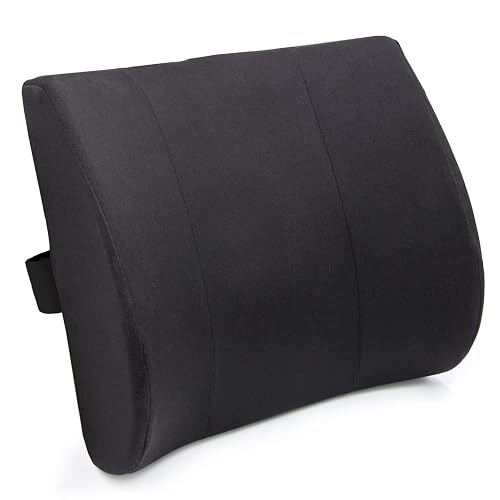
- A rigid composite-board insert sits behind the contoured foam to deliver the firmest back support in this test.
- The compact 14 x 13 x 5-inch shape targets the lumbar curve specifically rather than the whole back.
- Weighs about 1 pound and includes a removable, washable cover plus an elastic strap for $26.79.
Vekkia Lumbar Support Pillow for Office Chair

- Dedicated support zones for the upper back, lumbar curve, side waist, and lower back spread pressure across four areas.
- Dual-layer foam resists going rock-hard in winter or overly soft in summer, holding a consistent feel year-round.
- An anti-slip base plus dual straps and a buckle keep the $23.99 cushion planted on office and car seats.
FORTEM Memory Foam Lumbar Support Pillow

- At $22.99 it is the lowest-priced pillow here while still using 100% memory foam rather than shredded fill.
- Adjustable elastic straps fit office chairs, car seats, and wheelchairs without tools.
- The removable mesh cover machine washes and the pillow ships with a 1-year warranty.
I sat on each pillow across full eight-hour workdays over three weeks, rotating them between a mid-back task chair and a car seat, checking how far the foam compressed by day's end, whether the straps held position, and how the cover breathed. Scores were set before prices were compared.
Buying Guide
Firm vs. Plush: Choosing the Right Foam Density
Foam density is the single biggest factor in how a lumbar pillow feels after an hour of sitting. Plush, single-density memory foam like the $39.99 Everlasting Comfort Original conforms quickly and spreads pressure gently, which suits people who lean back lightly and want cushioning rather than correction. Firm, structured options like the DMI Contoured pillow go the other way: a rigid composite-board insert behind its 14 x 13 x 5-inch foam pushes back against your lumbar curve and refuses to compress, holding your pelvis upright even when you slump. Neither is objectively better. If you carry more weight or lean hard into your backrest, a soft pillow bottoms out and loses its shape by mid-afternoon, so a firmer core keeps working. If you sit lightly or have a sensitive lower back, an aggressively firm board can feel like a pressure point after two hours. A useful middle ground is heat-responsive foam, like the ComfiLife Premium uses, which starts firm and softens to your body over 2 to 3 minutes. Try to match density to your body weight and how much time you actually spend reclined versus upright.
Strap Systems and Chair Fit
A lumbar pillow only helps if it stays where you put it, and that comes down to the strap system. Most pillows use two elastic straps that loop around the backrest, but the number and adjustability matter more than you would expect. The ComfiLife Premium adds a third strap so it grips tall executive and mid-back chairs that would let a two-strap model slide down as you shift. The Everlasting Comfort Original includes extension pieces that stretch to fit chairs up to 32 inches wide, which covers most gaming chairs and wide recliners. Before buying, measure your backrest width and height: a pillow sized for a compact task chair can look oversized and crowd your shoulder blades on a small seat, while a standard pad can float loosely on a broad executive chair. Quick-release buckles, like the ones on the QUTOOL and Vekkia pillows, make it far easier to move the cushion between your desk chair and your car without re-threading straps every time. An anti-slip backing, which the Vekkia cushion adds, is a helpful backup that keeps the pillow from creeping down even when the straps loosen slightly.
Lumbar Pillow vs. Seat Cushion: Where Support Matters
Lumbar pillows and seat cushions solve different problems, and buyers often confuse them. A lumbar pillow sits vertically against the backrest and supports the inward curve of your lower spine, encouraging an upright pelvis and reducing the flattening that leads to slouching. A seat cushion sits horizontally under you and relieves tailbone and sciatic pressure. If your complaint is lower-back ache and a tendency to slump forward, the pillows in this guide are what you want; if your complaint is a sore tailbone from a hard chair, you need a coccyx seat cushion instead. Some people benefit from both, which is why brands like ComfiLife, QUTOOL, and Everlasting Comfort also sell matching seat cushions. Position is everything with a back pillow: the thickest part should land at your belt line, roughly where your lower back curves in most, not up between your shoulder blades. Mounted too high, a lumbar pillow pushes your upper back forward and creates the exact rounded posture you were trying to fix. Every model here, from the $22.99 FORTEM to the $39.99 Everlasting Comfort Original, is designed to slide up or down the backrest so you can find that belt-line sweet spot.
Cover Materials, Breathability, and Cleaning
Because a lumbar pillow presses against your back all day, the cover material decides how sweaty and how sanitary it stays. Breathable 3D mesh, used on the Everlasting Comfort Original, QUTOOL, and FORTEM pillows, lets air move through the fabric so your lower back does not get clammy during long sessions or in a warm car. The ComfiLife Premium mixes mesh on the contact face with wipe-clean leatherette on the sides, which is easier to wipe down but traps a little more heat. Every pillow in this roundup has a removable cover that zips off for machine washing, which matters more than it sounds: covers pick up sweat, hair, and oils, and a pillow you cannot clean becomes unpleasant within months. Check whether the cover is the only washable part, since the foam core itself should never go in a washing machine, where it will tear apart. For shared or office use, a cover you can pull off and wash weekly, like the ones on all six models here, keeps the pillow hygienic. Darker covers also hide everyday marks better than light gray if the pillow travels between your desk and your vehicle.
Frequently Asked Questions
What is the best lumbar support pillow overall?
For most people the Everlasting Comfort Original at $39.99 is the best all-around lumbar support pillow. It uses high-density memory foam that holds its ergonomic curve through 8-plus-hour workdays without flattening, and its dual straps include extension pieces that fit office and gaming chairs up to 32 inches wide. The removable 3D mesh cover zips off for machine washing and keeps airflow moving so your lower back does not get clammy. It strikes a balance between plush comfort and lasting support that suits the widest range of body types and chairs. If you want firmer, more corrective support, the DMI Contoured pillow at $26.79 adds a rigid composite-board insert that refuses to compress, while the ComfiLife Premium at $27.95 uses three straps for a more secure fit on tall chairs. But as a first pillow for a typical desk setup, the Everlasting Comfort Original is the safest recommendation.
How do I know if a lumbar pillow will fit my office chair?
Start by measuring your backrest width and height, then compare that to the pillow's strap reach. The Everlasting Comfort Original includes strap extension pieces that stretch to fit chairs up to 32 inches wide, which covers nearly every gaming chair and wide executive chair, while a standard two-strap pillow like the FORTEM at $22.99 suits average task chairs of roughly 18 to 22 inches. Chair height matters too: on a tall executive backrest, a two-strap model can slide down as you move, which is why the ComfiLife Premium adds a third strap to lock it in place. If your chair has a fixed, upright back with little recline, avoid the bulkiest options like the taller QUTOOL wedge, since a thick pillow can crowd you forward. A quick-release buckle, found on the QUTOOL and Vekkia pillows, makes fitting and removing far quicker. When in doubt, a mid-size pillow with adjustable straps fits the widest range of chairs.
Are memory foam lumbar pillows better than inflatable ones?
For daily desk use, solid memory foam is generally the better choice, and every pillow in this guide, from the $22.99 FORTEM to the $39.99 Everlasting Comfort Original, uses it rather than shredded fill or air. Memory foam contours to the specific shape of your lower spine and holds that shape consistently, so the support feels the same on hour one and hour eight. Inflatable lumbar pillows have one real advantage: you can dial the firmness up or down with a pump, and they pack flat for travel. The trade-offs are that they can develop slow leaks, feel like a hard balloon if overfilled, and shift position more easily. High-density foam like the QUTOOL's resists flattening and rebounds within seconds after a full workday, and firmer designs like the DMI Contoured pillow's board-backed core give a rigidity inflatables struggle to match without feeling taut. If you travel constantly and need packability, an inflatable has a place, but for a chair you sit in every day, foam wins on consistency and durability.
What is the best budget lumbar support pillow?
The FORTEM Memory Foam Lumbar Support Pillow at $22.99 is our budget pick, and it does not cut the corners that matter. It uses 100% memory foam rather than the cheap shredded fill found in many low-cost pillows, so it holds a consistent shape instead of clumping. Adjustable elastic straps fit office chairs, car seats, and wheelchairs without tools, and the removable mesh cover machine washes when it picks up sweat. FORTEM also backs it with a 1-year warranty, which is rare at this price. The compromises are modest: the foam is slightly thinner than the Everlasting Comfort Original's, so it compresses more under taller or heavier sitters, and it comes in a single size and color, limiting fit on very wide or very narrow chairs. The Vekkia pillow at $23.99 is the next step up and adds four-zone support and an anti-slip base for about a dollar more. But if you simply want reliable memory-foam lumbar support for the lowest price, the FORTEM is the one to buy.
How long do lumbar support pillows last before the foam breaks down?
A quality memory-foam lumbar pillow used daily typically holds its shape for two to four years before the foam starts to compress permanently and lose support. Density is the main predictor: the high-density foam in the Everlasting Comfort Original and QUTOOL pillows resists flattening far longer than the low-density foam in bargain-bin cushions, which can pack down within months. The board-backed DMI Contoured pillow lasts especially well because its rigid composite insert does the structural work while the foam only provides the contact surface. You can extend any pillow's life by rotating it if the design allows, keeping it out of direct sun and heat, which degrade foam faster, and washing only the cover, never the foam core, in a machine. Watch for the warning signs: if the pillow no longer springs back within a few seconds of standing up, or if you feel your backrest through the foam, the cells have collapsed and it is time to replace it. The FORTEM's 1-year warranty covers early failures within that window.
Can I use an office lumbar pillow in my car?
Yes, and most lumbar pillows in this guide are explicitly designed to move between an office chair and a car seat. The key feature is the strap system: pillows with quick-release buckles, like the QUTOOL at $29.99 and the Vekkia at $23.99, are the easiest to swap because you can unclip them from your desk chair and clip them onto your car seat in seconds without re-threading elastic loops. Fit is the main thing to check, since car seats are usually narrower and more contoured than office chairs. A slimmer pillow like the FORTEM or the compact 14 x 13 x 5-inch DMI Contoured pillow tucks into a bucket seat more cleanly than a wide wedge. Breathability also matters more in a hot car, so the mesh-covered Everlasting Comfort Original and FORTEM pillows stay cooler on your lower back than a leatherette-sided cover during a long summer drive. If you want two dedicated pillows, the budget FORTEM makes a sensible second unit to leave in the vehicle.
Where on my back should a lumbar pillow sit?
Position is the most common mistake people make with a lumbar pillow, and getting it right matters more than which model you buy. The thickest part of the pillow should land at your belt line, roughly where your lower spine curves inward the most, usually just above the top of your pelvis. Mounted there, the pillow pushes your lumbar curve forward and keeps your pelvis upright so your shoulders stack naturally over your hips. If you set it too high, up between your shoulder blades, it forces your upper back forward and creates the rounded, slouched posture you were trying to fix. Every pillow here, including the ComfiLife Premium and the Everlasting Comfort Original, uses adjustable straps so you can slide it up or down the backrest to find that sweet spot. Sit back fully so your spine meets the pillow, adjust the height until the support feels centered on your lower back, then tighten the straps. If you feel pressure higher up your spine, lower it an inch or two until only your lumbar region is supported.
Are lumbar support pillows good for existing back pain?
Lumbar support pillows can help reduce the mechanical strain that comes from prolonged slouched sitting, which is a common contributor to everyday lower-back discomfort. By holding your lumbar curve and keeping your pelvis upright, a pillow like the firm, board-backed DMI Contoured at $26.79 or the heat-responsive ComfiLife Premium at $27.95 reduces the disc loading that builds up when your spine flattens over hours at a desk. Public-health ergonomics guidance from OSHA and NIOSH recommends a backrest that supports the lumbar region for exactly this reason. That said, a pillow is a comfort and posture aid, not a medical treatment. If you have acute, severe, or persistent back pain, especially pain that radiates down a leg, is worse at night, or follows an injury, see a doctor or physical therapist rather than relying on a cushion. Used as part of a setup with a properly adjusted chair, regular movement breaks, and correct pillow placement at the belt line, a lumbar pillow is a low-cost way to make long sitting more comfortable for most people.
Our Verdict
For most people setting up a home office, the Everlasting Comfort Original at $39.99 is the lumbar pillow to buy: high-density foam that keeps its shape through long workdays, straps that fit chairs up to 32 inches wide, and a breathable, washable mesh cover. Shoppers who want firmer, more corrective support should choose the board-backed DMI Contoured pillow at $26.79, which refuses to compress under a slump. If budget is the priority, the FORTEM at $22.99 delivers real memory foam, a washable cover, and a 1-year warranty for the lowest price here, while the ComfiLife Premium at $27.95 is the pick for tall executive chairs thanks to its third strap. Match density and strap fit to your chair and body, and place the pillow at your belt line.
Sources
- Computer Workstations eTool - Chair and Backrest — OSHA
- Ergonomics and Musculoskeletal Disorders — CDC / NIOSH
- Low Back Pain Fact Sheet — NIH / NINDS