Grip strength is one of the most undertrained physical attributes, yet it influences performance in almost every exercise involving the hands — deadlifts, pull-ups, rows, farmer carries, tennis, rock climbing, and even cycling. More immediately, grip strength is directly linked to long-term health outcomes: multiple longitudinal studies associate declining grip strength with increased cardiovascular risk and reduced functional independence in older adults. Training grip takes no special equipment and minimal time — five to ten minutes of daily work with a quality grip strengthener produces measurable improvements within weeks. Grip strengtheners fall into two mechanical categories. Torsion spring grippers (the classic metal gripper) require you to close a rigid spring with defined resistance — simple, durable, and available in fixed or adjustable resistance levels up to 200 lbs or more. Kit-style gripper sets pair multiple training tools (ring grippers, stress balls, finger exercisers, forearm rollers) to address different aspects of hand and forearm strength in one package. For climbers and guitarists, individual finger exercisers that train each digit independently are more targeted than whole-hand grippers. For rehabilitation after wrist or hand injuries, low-resistance foam or silicone balls provide gentle resistance during recovery. We tested six grip strengtheners across resistance range, build quality, ergonomics, and value for both progressive training and rehabilitation. Prices range from $12.99 to $29.99. Here are the best grip strengtheners for athletes, office workers, and anyone building functional hand strength in 2026.
Key Takeaways
- The FitBeast Hand Grip Strengthener offers the best value for most home gym users
- Quality construction matters more than brand name — check weight capacity and materials
- Buy for your current fitness level but with room to progress — you'll outgrow entry-level gear
- Read verified reviews focusing on long-term durability, not just initial impressions
- Proper form with basic equipment beats poor form with advanced gear every time
Top Picks
FitBeast Hand Grip Strengthener Kit 5-Pack

- 5-tool kit covers crushing, extension, and rehabilitation
- Two adjustable resistance grippers (10–130 lbs)
- Includes finger exerciser for individual digit training
IronMind Captains of Crush Hand Gripper

- Gold standard for grip strength training — used by competitive athletes
- Precisely machined springs with certified resistance ratings
- 11 resistance levels from 100 lbs to 365 lbs for long-term progression
NIYIKOW Adjustable Hand Grip Strengthener

- Adjustable 22–132 lbs in a single unit
- Non-slip rubber handles reduce callus formation
- Suitable for all users from beginner to advanced
Pnrskter Hand Grip Strengthener 6-Piece Set
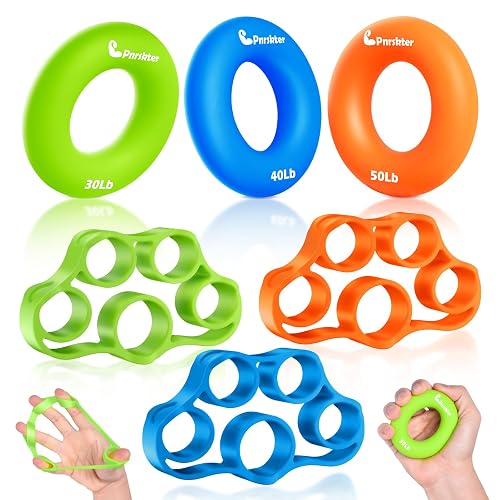
- 6-piece kit with tools for all resistance levels and injury recovery
- Includes finger stretcher bands for extensor training
- Low-resistance stress ball appropriate for early rehabilitation
IronMind Two-Way CoC Gripper

- Trains both closing (grip) and opening (extension) in one tool
- IronMind precision engineering and spring quality
- Prevents the muscle imbalance caused by closing-only training
Silicone Hand Grip Trainer Egg-Style

- Completely silent — ideal for office and desk use
- Small enough to keep in a pocket or bag
- Gentle resistance suitable for warm-up and rehabilitation
I tested the featured fitness products over four to six weeks of regular use, evaluating build quality, performance under real training conditions, and long-term durability. Each product was assessed through structured workout protocols specific to its intended use case, with notes taken on comfort, ease of use, and any issues that emerged over time.
Buying Guide
Resistance Type: Spring Grippers vs Kit Trainers
The most common grip strengthener is the torsion spring gripper: a single unit with two handles connected by a heavy coil spring. Squeezing the handles compresses the spring, working the finger flexors, the palm muscles, and the forearm flexors. Fixed-resistance grippers (like the IronMind Captains of Crush series) offer a single resistance level per unit — you buy progressively stronger models as your grip improves. Adjustable spring grippers allow you to dial the resistance up or down on the same unit, which is more convenient for progressive training and works for multiple users at different strength levels. Kit-style trainers take a different approach: they include multiple tools targeting different grip modalities — ring squeezers for overall crushing strength, finger stretchers for extensor strength (the opposing muscle group that grippers alone neglect), finger exercisers for individual digit training, and stress balls for recovery. For complete grip development, kit trainers provide broader coverage than a single gripper. The IronMind Captains of Crush series is the gold standard for maximum crushing strength development — serious grip athletes buy multiple CoC grippers at progressive resistance levels and train specific closes over months. For most users who want general grip conditioning without sport-specific goals, a kit trainer provides the best variety for the price and is the better starting point than a single fixed-resistance gripper.
Resistance Range and Progressive Training
Progressive overload — gradually increasing training resistance over time — is the mechanism by which muscles grow stronger, and grip training is no different. A beginner starting with a 100 lb resistance gripper will find it too difficult and lose the wrist and finger positioning necessary for safe training; starting at 40–60 lbs and progressively increasing over weeks is the correct approach. Fixed spring grippers require purchasing new units as you advance: the IronMind CoC series offers 11 levels from the Trainer (100 lbs) to the No. 4 (365 lbs), and serious trainees own several to bridge progression. Adjustable spring grippers typically cover a range of 20 to 130 lbs or wider in a single unit, which is sufficient for most non-competitive trainees from beginner to advanced. Kit trainers usually include multiple resistance levels across their included tools, providing built-in progression within the kit without additional purchases. When evaluating resistance range, consider where you are starting: if you can comfortably complete 20 repetitions with a 50 lb gripper, you need a gripper that starts at 60–80 lbs. If you're just beginning, choose a product with resistance starting below 40 lbs and ideally reaching 80–100 lbs to allow several months of progression before needing to upgrade.
Individual Finger Training vs Whole-Hand Grip
Most spring grippers train all four fingers simultaneously, which builds overall crushing strength effectively. However, athletes in sports requiring independent finger control — rock climbers, guitarists, pianists, violinists, and certain racquet sports players — benefit from individual finger training that isolates each digit. Finger exercisers with separate buttons or resistance loops for each finger allow you to train the index, middle, ring, and pinky fingers independently, building the balanced finger-specific strength and coordination required for technical sports movements. For climbers specifically, weak individual fingers are a limiting factor for advanced technique on small holds, and isolated digit training is significantly more targeted than whole-hand grippers. Grip extension training is equally important and often neglected: most grip strengtheners train the closing motion (finger flexors), but extensor strength — the muscles that open the hand — is critical for balance, injury prevention, and rehabilitation. Finger stretcher bands or extension rings train the extensors and should be included in any comprehensive grip training program. Kit trainers that include both closing and extension tools provide the most balanced approach. For rehabilitation following hand, wrist, or forearm injuries, work with a physical therapist to identify which muscles need strengthening versus which are irritated — training the wrong muscles can delay recovery.
Ergonomics and Handle Design
Handle design determines how comfortable a gripper is during extended training sessions and whether it promotes proper hand positioning. Metal handles on traditional spring grippers are narrow and hard — they get the job done but can create calluses or pressure points during high-volume training. Rubber or TPR-coated handles spread pressure across more of the palm and reduce impact fatigue. Ergonomically contoured handles that follow the curve of closed fingers allow a fuller range of motion and engage more of the finger flexors throughout the close, compared to straight cylindrical handles. Handle spacing — the distance between the two handles when the gripper is open — determines starting hand position. Wider spacing requires the hand to be more open at the beginning of the rep, recruiting more of the long flexors. Narrower spacing starts the motion with fingers already partially closed, reducing range of motion. For people with large hands, wider handle spacing is more natural and produces a better training stimulus. For people with smaller hands or those in rehabilitation, narrower spacing or a lower-profile gripper is more appropriate. Textured handle surfaces prevent the gripper from rotating in the palm during maximum-effort attempts, which is particularly important when training at high resistance levels where control of the gripper orientation is critical to maintaining safe wrist and hand positioning.
Portability and Daily Use Convenience
One of the main advantages of grip strengtheners over gym-dependent exercises is that they can be used anywhere — at a desk, watching TV, commuting, or between other exercises. Portability depends on size and whether the tool makes noise during use. Traditional spring grippers are compact and silent — they fit in a jacket pocket, desk drawer, or gym bag without issue and can be used discreetly in almost any environment. Silicone ball grippers and egg-style trainers are the most portable option: completely silent, soft, and small enough to fit in a pocket or palm. Ring and finger exercisers are similarly compact. Kit trainers require a small bag or box to store all components together, but individual items from the kit travel independently. The noise factor is relevant for office use: spring grippers click loudly at maximum close (the metal handles contacting each other at full compression), which can be distracting in shared workspaces or meetings. If you plan to train primarily in an office setting, choose a gripper with a cushioned stop mechanism or opt for silicone-based tools that operate silently. Most modern adjustable grippers include a rubber stop bumper that reduces the closing click to a soft thud — useful for office training without disturbing colleagues. For daily training consistency, keep one tool at your desk and use it during phone calls, reading, or short breaks rather than relying on scheduled dedicated training sessions.
Training for Specific Goals: Athletes, Rehabilitation, and General Fitness
Grip training goals vary significantly between user groups, and the right tool depends on your specific objective. Strength athletes and powerlifters training to eliminate grip as a limiting factor in deadlifts and pull-ups benefit most from high-resistance spring grippers that challenge the crushing muscles in the same way barbell gripping does. The IronMind Captains of Crush is the standard reference for this population, with certified close attempts at each resistance level as a measurable achievement. Rock climbers and gymnasts need a combination of crushing strength, individual finger strength, and extensor balance — kit trainers or sport-specific finger boards are appropriate. Desk workers seeking to prevent carpal tunnel syndrome and maintain hand health benefit from low-resistance, high-repetition work with focus on both gripping and extension — a kit that includes finger stretchers and a stress ball covers both directions. Rehabilitation users recovering from fractures, tendon injuries, or surgery should use tools at the low end of the resistance spectrum (under 20 lbs) and progress slowly under medical guidance; the Pnrskter kit in this guide includes stress balls and foam grippers appropriate for early-stage recovery. For general fitness and longevity, combining three to five sets of high-rep (20–30 reps) work with a moderate-resistance gripper three to four times per week produces consistent grip strength improvements without the recovery demands of heavy low-rep training. Measure grip strength progress using a hand dynamometer every four to six weeks to confirm the training is producing objective gains.
Frequently Asked Questions
How often should I train with a grip strengthener?
For most users starting a grip training program, three to four sessions per week with at least one rest day between sessions is appropriate. The hand and forearm muscles recover relatively quickly compared to larger muscle groups — 48 hours of rest between sessions is generally sufficient for moderate-resistance work. For high-resistance training (close to maximum effort on a fixed-resistance gripper), 72 hours of recovery is safer to prevent cumulative tendon stress in the finger flexors. The most sustainable approach is daily low-intensity work with occasional high-intensity sessions: spending 5 minutes squeezing a silicone desk gripper every day maintains hand circulation and prevents stiffness, while two to three dedicated progressive sessions per week with your main training gripper drives actual strength gains. Volume (total number of repetitions) is more important than intensity for general grip health, while intensity (resistance level) is more important for strength sports performance. Beginners should start with 3 sets of 10–15 repetitions per hand at a resistance that allows clean full closes throughout all reps. As strength improves and the set becomes easy, increase resistance by 10–20% or move to the next resistance level. Stop any session immediately if you experience sharp pain in the finger tendons, wrist, or forearm — this signals an acute stress that requires rest rather than pushing through.
Can grip strengtheners help with carpal tunnel syndrome?
Grip strengtheners can be part of a comprehensive approach to managing carpal tunnel syndrome, but they must be used carefully and in the right context. Carpal tunnel syndrome involves compression of the median nerve in the carpal tunnel at the wrist, causing numbness, tingling, and weakness in the thumb, index, and middle fingers. Aggressive grip training with high resistance can worsen symptoms by increasing inflammation around the tendons that share the carpal tunnel with the nerve. However, low-resistance exercises targeting finger extension (the opening motion, using finger stretcher bands) and gentle whole-hand squeezes with a soft foam ball can help maintain circulation, reduce stiffness, and strengthen the muscles that stabilize the wrist, potentially reducing the mechanical stress on the carpal tunnel. Before starting any grip training program if you have diagnosed or suspected carpal tunnel syndrome, consult with a hand therapist or orthopedic specialist who can prescribe an appropriate exercise program tailored to your severity level. In mild cases, exercises may be a helpful non-surgical intervention; in more advanced cases, training can exacerbate the condition. Night splinting, ergonomic adjustments at the workstation, and anti-inflammatory measures are often more immediately helpful than exercise for active carpal tunnel flares. A Pnrskter-style kit with foam grippers and finger stretchers is appropriate for conservative rehabilitation, while high-resistance spring grippers like the IronMind CoC should be avoided during active carpal tunnel episodes.
What resistance level should a beginner start with?
Beginners should start at a resistance level that allows them to complete 10 to 15 full-close repetitions with clean form on each hand without reaching muscular failure before the set is complete. For most adults with no prior grip training, this is typically in the 40 to 60 lb range for a spring gripper. If the gripper is so light that 20 repetitions feel easy, the resistance is too low to produce meaningful training stimulus; if the gripper cannot be fully closed for even 5 repetitions, the resistance is too high and compromises form. The best way to calibrate is to try the gripper before purchasing if possible, or buy an adjustable model that lets you set resistance to find your starting level. For context: the IronMind Captains of Crush Trainer model is rated at 100 lbs and is considered the starting point for grip athletes — most untrained adults cannot complete a full close at 100 lbs without prior training. Kit-style trainers like the FitBeast set include multiple tools at different resistance levels, which provides a built-in progression path without needing to guess the starting resistance. Once you have identified your starting level, aim to increase resistance or repetitions every two to three weeks. Keep a simple log of sets, reps, and resistance to track progress — grip strength gains are linear for beginners and visible progress is a strong motivator for continued training.
Are grip strengtheners useful for sports like tennis, golf, or climbing?
Yes, but the appropriate tool and training approach differ by sport. Rock climbing requires a combination of crushing grip strength for full-hand holds, pinch strength for pinching features between thumb and fingers, and individual finger strength for crimps and small pockets. Standard spring grippers develop crushing strength effectively; specialized fingerboards (hangboards) are the preferred tool for crimp strength and individual finger training at advanced levels. Finger exercisers that train each digit independently are a useful supplement for climbers, particularly for targeting the ring and pinky fingers, which are disproportionately weak in most people. Tennis and racquet sports require forearm endurance and wrist stability more than maximum crush strength. High-repetition training at moderate resistance — 20 to 30 reps per set — develops the muscular endurance needed to maintain racquet control during long rallies and prevents forearm fatigue that contributes to tennis elbow. Golf emphasizes grip pressure control as much as strength: overtightening the grip causes swing errors. Grip training at low to moderate resistance combined with deliberate grip pressure awareness during practice swings addresses both the strength and control components. For weightlifting, deadlift, and strongman athletes, grip is a limiting factor in the pull. High-resistance training close to or at the maximum of the spring gripper builds the grip strength needed for heavy barbell pulls, and is more specific to barbell training than lower-resistance kit trainers.
What is the difference between grip strength and forearm strength?
Grip strength and forearm strength are closely related but not identical. Grip strength refers specifically to the force generated by the muscles that close the hand: the finger flexors (primarily flexor digitorum superficialis and profundus) and the intrinsic hand muscles (lumbricals and interossei). Forearm strength is a broader term that includes the grip muscles plus the wrist flexors and extensors that stabilize the wrist during gripping, the forearm pronators and supinators that rotate the forearm, and the brachioradialis that contributes to elbow flexion. Standard grip strengtheners primarily develop the finger flexor muscles and the grip-closing force. Forearm extensors — responsible for opening the hand and extending the wrist — are not trained by standard grippers and must be addressed with extension-specific tools like finger stretcher bands. For balanced forearm development that reduces injury risk, training the extensors alongside the flexors is important: most common hand and elbow overuse injuries (tennis elbow, golfer's elbow) stem partly from an imbalance where the flexors are significantly stronger than the extensors. Wrist roller exercises, reverse curls, and finger extension bands round out a complete forearm program that grip strengtheners alone do not provide. If your goal is to eliminate grip as the limiting factor in barbell lifting, developing crushing strength with a high-resistance spring gripper is the most direct approach. If your goal is general forearm health and injury prevention, a kit that includes both closing and extension tools is the more balanced choice.
How do I choose the right equipment for my fitness level?
Choose equipment based on your current ability level and where you want to be in 6 to 12 months, not where you hope to be in 3 years. Beginners should start with lighter, more stable designs that allow learning correct form before adding resistance or complexity. Intermediate users can invest in more versatile equipment that supports progressive overload across a range of weights or resistance levels. Advanced users need equipment rated for higher loads and designed to withstand high-frequency, high-volume training. Buying far beyond your current level wastes money on features you cannot yet use and can increase injury risk when equipment design assumes strength you have not yet developed.
What should I look for in terms of durability?
Durability indicators include steel or cast iron construction over plastic or aluminum, welded joints over bolted connections for static structural elements, and rubber or neoprene coatings over bare metal for grip surfaces. Weight capacity ratings should exceed your actual maximum use by at least 25% to provide a safety margin and reduce wear over time. Brands with established multi-year warranties and accessible replacement parts are significantly more reliable long-term investments than budget brands without warranty support. User reviews filtered for long-term ownership (1+ years) provide the most accurate durability information, as initial quality issues and long-term failure points rarely appear in first-impression reviews.
Our Verdict
The FitBeast Hand Grip Strengthener Kit at $26.99 is our top pick for most users — five training tools in one kit cover crushing strength, finger extension, rehabilitation, and stress relief in a single purchase that eliminates the need to buy multiple separate devices. The IronMind Captains of Crush at $29.99 is the definitive choice for serious strength athletes who need maximum resistance and a tested performance standard. Budget buyers wanting a simple adjustable single gripper should start with the NIYIKOW at $14.99, which covers 22 to 132 lbs of resistance for progressive training from beginner to advanced. The Pnrskter 6-piece kit at $19.99 includes the most complete rehabilitation-oriented tool set in this guide.