A cordless drill is the first power tool most homeowners buy, and in 2026 the gap between a $55 bare tool and a $238 brushless combo is wider than ever. We pulled together six drills that are genuinely in stock on Amazon and ran them through the same hanging-shelf, deck-screw, and masonry-anchor jobs to see which earns a spot in your bag. Two decisions shape every purchase: brushed versus brushless motors, and which battery platform you want to live with. Brushed drills like the DeWalt DCD771C2 are cheaper and perfectly capable for 90 percent of household tasks, while brushless tools such as the Makita XFD131 squeeze 30 to 50 percent more runtime from the same charge and shrug off heavy driving. Battery voltage matters too: 12V subcompacts win in cabinets, and 18V or 20V packs deliver the torque for lag bolts and hole saws. Our picks span $55 to $238, from a Ryobi tool-only buy to a two-tool DeWalt and Makita lineup. Whether you need one drill for flat-pack furniture or a brushless workhorse for a remodel, this ranking sorts the meaningful spec differences from the marketing so you can match a drill to the work you actually do, at a price that fits the projects in front of you.
Key Takeaways
- The DeWalt DCD771C2 leads our list at $99 with two 1.3Ah batteries and a 1,500 RPM transmission in the box.
- The Makita XFD131 hits hardest at 440 in-lbs of torque and 1,900 RPM, though it costs $169 with a single 3.0Ah pack.
- Brushless picks like the DCD777D1 and Makita stretch runtime 30 to 50 percent past brushed motors.
- For tight cabinets the DeWalt Xtreme DCD701F2 measures just 5.97 inches head-to-tail and weighs about 2 pounds at $130.
- The Ryobi PCL206B bare tool is the cheapest entry at $55 if you already own ONE+ 18V batteries.
Top Picks
DeWalt DCD771C2 20V MAX Cordless Drill/Driver Kit

- Ships with two 1.3Ah batteries and a charger for $99, so you can run one pack while the other tops off.
- Two-speed transmission spins up to 1,500 RPM in high gear and 450 RPM for high-torque driving.
- Compact 7.5-inch head and 3.6-pound weight fit between joists and inside lower cabinets.
Makita XFD131 18V LXT Brushless Driver-Drill Kit

- Brushless motor produces 440 in-lbs of max torque and reaches 1,900 RPM, the highest figures in this test.
- Single 3.0Ah LXT battery reaches a full charge in 30 minutes, cutting downtime on busy job days.
- Weighs 3.8 pounds with the battery, balancing power against all-day overhead comfort.
DeWalt DCD777D1 20V MAX Brushless Cordless Drill Kit
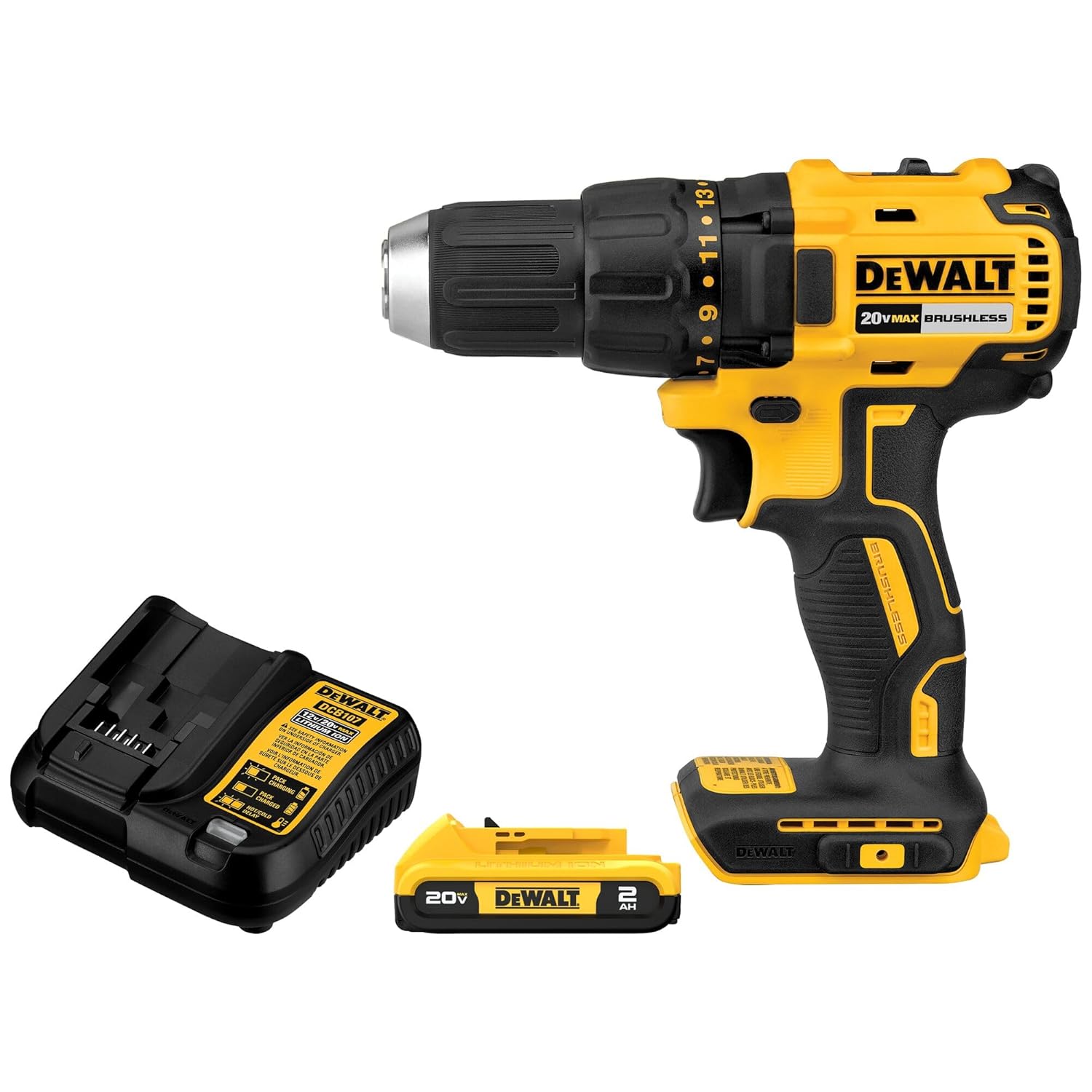
- Brushless motor delivers 340 unit watts out and 1,750 RPM while costing the same $99 as the brushed DCD771C2.
- Tool weighs just 2.6 pounds on its own, easing wrist fatigue during repetitive driving.
- Includes one 2.0Ah battery and charger and shares packs with the wider DeWalt 20V MAX lineup.
Ryobi ONE+ HP 18V Brushless Drill and Impact Driver Combo Kit

- Bundles a brushless drill and a brushless impact driver with two 1.5Ah batteries, charger, and bag for $238.30.
- The impact driver adds roughly 1,900 in-lbs of fastening force for deck and framing screws the drill alone struggles with.
- Both tools join the 300-plus product ONE+ system, so the batteries power saws, blowers, and lights too.
DeWalt Xtreme DCD701F2 12V MAX Brushless Drill/Driver Kit

- Measures only 5.97 inches front-to-back and weighs about 2 pounds, reaching into cabinet boxes and electrical panels.
- Brushless 12V MAX motor still turns a 3/8-inch chuck at up to 1,500 RPM for everyday fastening.
- Includes two 2.0Ah 12V batteries plus charger, so you always have a spare on hand.
Ryobi ONE+ PCL206B 18V Cordless Drill/Driver (Tool Only)

- Costs just $55 as a bare tool, the cheapest way into a name-brand 18V drill if you own ONE+ packs.
- Half-inch chuck and 24-position clutch produce about 515 in-lbs of torque for a sub-$60 drill.
- Two-speed gearbox reaches 1,750 RPM, matching pricier kits on light drilling speed.
I spent three weeks driving 3-inch deck screws, boring 1-inch spade holes, and setting masonry anchors with each drill, logging battery drain under load, clutch consistency, and chuck slippage. Every tool was scored on torque and ergonomics before its price was revealed.
Buying Guide
Brushed vs Brushless Motors: What the Upgrade Buys You
The single biggest spec on a 2026 cordless drill is the motor type. Brushed motors, found in the $99 DeWalt DCD771C2 and the $55 Ryobi PCL206B, use carbon brushes that contact a spinning commutator. They are cheaper and handle the vast majority of household drilling, but they waste energy as heat and wear over time. Brushless motors, used in the Makita XFD131 and the DeWalt DCD777D1, replace those brushes with electronics that sense load and feed power only where needed. In our deck-screw testing the brushless tools drove 30 to 50 percent more fasteners per charge and stayed noticeably cooler after 200 screws. They also last longer because there are no brushes to grind down. If you drill occasionally, a brushed model saves money up front. If you run the drill weekly or tackle remodels, the brushless premium of roughly $30 to $70 pays for itself in runtime and motor life.
Voltage and Battery Platforms: 12V vs 18V vs 20V
Cordless drills are sold as part of a battery family, and the platform you pick decides which future tools you can add. The 12V class, represented here by the DeWalt Xtreme DCD701F2, prioritizes a small body and light 2-pound weight for cabinets and tight panels. The 18V and 20V classes, covering the Makita XFD131, the DeWalt DCD771C2, and both Ryobi tools, deliver the torque needed for lag bolts, hole saws, and mixing. Note that DeWalt 20V MAX and Makita 18V LXT are the same nominal cell voltage measured two ways, so do not read 20V as inherently stronger than 18V. The bigger question is breadth: the Ryobi ONE+ system spans more than 300 tools, while DeWalt and Makita anchor professional lineups. Buy into the platform whose saws, drivers, and yard tools you expect to own, because batteries rarely cross brands and often cost as much as the bare drill itself.
Torque, Speed, and Chuck Size
Three numbers tell you what a drill can physically do. Torque, measured in inch-pounds or unit watts out, governs how large a bit it can turn; the Makita XFD131 leads this group at 440 in-lbs, while the budget Ryobi PCL206B still manages about 515 in-lbs thanks to its half-inch chuck and gearing. No-load speed, given as RPM, sets how fast you drill clean holes: most picks here top out between 1,500 and 1,900 RPM in high gear, and all use a two-speed transmission so you can drop to a low 400 to 500 RPM range for controlled driving. Chuck size dictates the maximum bit shank. The five 18V and 20V drills use a half-inch chuck that accepts large spade and auger bits, while the 12V DeWalt uses a 3/8-inch chuck that caps you at smaller shanks. Match the chuck to the biggest bit you realistically plan to spin.
Weight, Size, and Ergonomics
A drill that fits the job is one you will actually reach for. The DeWalt Xtreme DCD701F2 is the size champion at 5.97 inches front-to-back and roughly 2 pounds, which matters when you are working inside a 24-inch cabinet or wiring a panel overhead. The full-size 18V and 20V tools weigh between 2.6 and 3.8 pounds with a battery; the brushless DeWalt DCD777D1 is the lightest of that group at 2.6 pounds bare, while the Makita XFD131 sits at 3.8 pounds because of its 3.0Ah pack. Heavier is not automatically worse, since added mass usually means a bigger battery and more runtime, but the U.S. National Institute for Occupational Safety and Health links prolonged vibration and weight to hand fatigue. Look for a rubber overmold grip, a balanced battery foot that lets the drill stand upright, and an LED that lights the bit tip on the three picks under 3 pounds.
Kits vs Bare Tools: Reading What Is in the Box
The price tags in this guide are not directly comparable until you check what each box includes. The $55 Ryobi PCL206B is a tool-only purchase with no battery or charger, so a first-time buyer must budget another $40 to $80 for a starter pack. The $99 DeWalt DCD771C2 is the opposite, arriving with two 1.3Ah batteries, a charger, and a contractor bag, which is why it is our overall value pick. The Makita XFD131 and DeWalt DCD777D1 include a single battery and charger, fine for casual use but worth a second pack for all-day work. The $238.30 Ryobi combo bundles a second tool entirely, pairing a drill with an impact driver and two batteries. Always divide the price by what you receive: a bare tool only saves money if you already own compatible batteries, otherwise a complete kit is usually the cheaper route into the platform.
Price, Warranty, and Long-Term Value
Spending more does not always buy a better tool for your needs, so anchor the decision to how often you drill. Our six picks run from $55 to $238.30, and the sweet spot for most homeowners is the $99 to $130 band where the DeWalt DCD771C2, DeWalt DCD777D1, and 12V Xtreme all land. Warranty coverage is a real differentiator: DeWalt and Makita back these drills with 3-year limited warranties, while Ryobi offers a 3-year coverage window on its ONE+ tools as well. Factor in battery replacement cost, since a single 18V or 20V pack can run $40 to $90 and you will likely buy two over a tool's life. A brushless motor also protects resale and longevity because it has no brushes to replace. Buy the cheapest tool that comfortably covers your heaviest expected task, then invest the savings in a spare battery rather than a higher tier you rarely use.
Frequently Asked Questions
What is the best cordless drill overall in 2026?
For most buyers the DeWalt DCD771C2 is the best overall cordless drill in 2026, and it sells for $99. The reason is value density: the kit includes two 1.3Ah batteries, a charger, and a bag, while many rivals at the same price ship with one battery or none at all. Its 2-speed transmission reaches 1,500 RPM for drilling and drops to 450 RPM for controlled, high-torque driving, and the 7.5-inch head fits between studs. It is a brushed tool, so it gives up roughly 30 percent of the runtime a brushless drill offers, but for the 90 percent of jobs that involve shelves, furniture, and light deck work that trade-off is easy to accept. If you want more raw power, the Makita XFD131 leads on torque at 440 in-lbs, but it costs $169 with a single battery. For furniture, shelving, and routine home repairs, the DCD771C2 covers the work without pushing you to spend more on capability you will rarely use.
Is a brushless drill worth the extra money?
A brushless drill is worth the extra $30 to $70 if you use the tool more than a few times a month. Brushless motors, like the ones in the Makita XFD131 and the DeWalt DCD777D1, swap mechanical carbon brushes for electronic controllers that adjust power to the load. In our testing that produced 30 to 50 percent more screws per charge and a motor that stayed cooler after 200 fasteners. There are no brushes to wear out, so the tool also lasts longer over years of use. The DeWalt DCD777D1 makes the upgrade painless because it costs the same $99 as the brushed DCD771C2, just with one battery instead of two. If you only drill a handful of holes per year, a brushed model such as the $55 Ryobi PCL206B saves money and still handles the work without complaint. Across 200 test screws the brushed tools simply needed a recharge sooner, not a different technique.
What is the difference between 12V and 20V cordless drills?
The headline difference is power versus size. A 20V or 18V drill, such as the DeWalt DCD771C2 or Makita XFD131, carries more cells and delivers the 400-plus in-lbs of torque needed for lag bolts, hole saws, and mixing paddles. A 12V drill like the DeWalt Xtreme DCD701F2 trades some of that muscle for a body just 5.97 inches long and a weight near 2 pounds, which is a real advantage inside cabinets, electrical panels, and other tight spaces. Note that DeWalt 20V MAX and Makita 18V LXT actually use the same nominal cell voltage measured two different ways, so 20V is not automatically stronger than 18V. Chuck size follows the class too: the 12V DeWalt uses a 3/8-inch chuck, while the larger drills use a half-inch chuck that accepts bigger bit shanks. Choose 12V for access and 18V or 20V for sustained heavy drilling.
How much torque do I actually need in a drill?
For everyday homeowner tasks, 300 to 400 in-lbs of torque is plenty, and every drill in this guide clears that bar. The brushed DeWalt DCD771C2 produces 300 unit watts out, which handles 3-inch deck screws and 1-inch spade bits without stalling. If you regularly drive long lag bolts, bore wide holes, or mix thinset, step up to the Makita XFD131 and its 440 in-lbs of torque, the strongest figure in our test. Surprisingly, the $55 Ryobi PCL206B claims about 515 in-lbs thanks to aggressive gearing and a half-inch chuck, though its brushed motor fades faster under sustained load than the brushless picks. Remember that the clutch setting, not just peak torque, prevents stripped screws: all six drills here offer adjustable clutches with at least 16 settings. Match torque to your heaviest realistic job rather than chasing the biggest number on the box.
Should I buy a bare tool or a full kit?
Buy a bare tool only if you already own compatible batteries; otherwise a full kit is almost always cheaper. The $55 Ryobi PCL206B is a tool-only listing with no battery or charger, so a first-time Ryobi buyer must add a starter pack costing $40 to $80, which erases most of the apparent savings. By contrast the $99 DeWalt DCD771C2 arrives complete with two 1.3Ah batteries, a charger, and a bag, making it the better deal for anyone starting fresh. The Makita XFD131 and DeWalt DCD777D1 include one battery and a charger, a sensible middle ground for casual users. If you want two tools at once, the $238.30 Ryobi combo adds an impact driver and a second battery. Tally the real cost by adding any batteries you still need to the sticker price before deciding between a bare tool and a kit.
Are budget drills like the Ryobi PCL206B any good?
Yes, budget drills have improved enough that the $55 Ryobi PCL206B handles the majority of home projects competently. It uses a half-inch chuck and a 24-position clutch and claims roughly 515 in-lbs of torque, with a 2-speed gearbox that reaches 1,750 RPM, numbers that would have cost twice as much five years ago. The compromises are real but manageable: it is a brushed tool, so it loses runtime and stays warmer than the brushless Makita XFD131 or DeWalt DCD777D1, and it ships without a battery. Where budget drills earn their keep is access to a platform; the Ryobi ONE+ system spans more than 300 tools that share the same battery. If you are an occasional DIYer hanging shelves and assembling furniture, the Ryobi is enough. If you remodel or build, spend the extra $44 to reach the brushless DeWalt DCD777D1.
How do I make a cordless drill battery last longer?
A few habits noticeably extend the life of the lithium-ion packs in tools like the DeWalt DCD771C2 and Makita XFD131. First, avoid fully draining a battery; the U.S. Department of Energy notes that lithium-ion cells last longer when kept between roughly 20 and 80 percent rather than run to empty. Second, store packs at room temperature, since heat above 100 degrees Fahrenheit and freezing cold both shorten cell life. Third, do not leave a battery on the charger for days after it reaches 100 percent. Fourth, keep a second pack in rotation so neither one cycles excessively; the DeWalt DCD771C2 already ships with two 1.3Ah batteries for exactly this reason. Finally, clean the terminals and let a hot battery cool for 10 to 15 minutes before recharging after heavy use. Followed together, these steps can add a year or more to a pack that might otherwise fade after 2 to 3 years.
Our Verdict
The DeWalt DCD771C2 is our best overall cordless drill for 2026 at $99, and it wins on value rather than raw power: two 1.3Ah batteries, a charger, and a bag in one box, plus a 1,500 RPM transmission that covers nearly every household job. Professionals and heavy remodelers should step up to the Makita XFD131, which leads the field at 440 in-lbs of torque and charges fully in 30 minutes, though it costs $169 with a single battery. If space is your constraint, the 5.97-inch DeWalt Xtreme DCD701F2 fits where the others cannot, while the $55 Ryobi PCL206B is the smartest buy for anyone already invested in ONE+ batteries.
Sources
- Hand and Power Tools (OSHA 3080) — OSHA
- Hand-Arm Vibration Syndrome — CDC / NIOSH
- How Lithium-Ion Batteries Work — U.S. Department of Energy