Agility ladders are the cheapest, most portable way to build the quick feet that soccer, basketball, and football players rely on, and the 2026 field runs from a $9 roll-up nylon ladder up to a $160 rigid system with electronic timing gates. A speed ladder lies flat on the ground so you can run through it with high knees, lateral shuffles, and in-and-out steps that train coordination, reaction time, and foot speed. After testing the leading options on turf, gym floors, and a concrete driveway, we found the category splits cleanly into roll-up nylon ladders and rigid accordion-fold frames. The right pick depends on how seriously you train and where you train. Roll-up nylon ladders pack into a bag about the size of a water bottle and cost under $15, which makes them ideal for solo athletes and parents outfitting a backyard. Rigid quick ladders such as the SKLZ Pro hold their spacing without stakes and survive years of cleats, but they cost more and take up more room. We also separated single ladders from full training sets that add hurdles, cones, and a resistance parachute for a complete agility session. Length and rung count matter too. Most ladders ship in 8-rung (about 4 meters), 12-rung (about 6 meters), and 20-rung (about 10 meters) sizes, and several let you slide the rungs to change spacing for different drills. Below are the six agility ladders in our 2026 rankings, with the prices, specs, and trade-offs that decided the order.
Key Takeaways
- The SKLZ Speed and Agility Ladder Pro leads at $72.99 with a tangle-free accordion frame and 7 adjustable rungs that hold their spacing without stakes.
- On a tight budget, the Yes4All Agility Ladder starts at $8.96 and slides to spacing between roughly 4 and 15 inches across 8, 12, or 20 rungs.
- The $30.99 Speed and Agility training set bundles a 20-foot ladder with 4 hurdles, 12 cones, and a resistance parachute for a full session.
- The ProsourceFit Speed Agility Ladder from $9.50 ships in 4-meter, 6-meter, and 10-meter lengths so you can match the size to your space.
- For coaches, the $159.98 SKLZ Quick Ladder adds electronic speed gates that time sprints up to 20 yards and store your last 50 runs.
Top Picks
SKLZ Speed and Agility Ladder, Pro, 10'

- Extends to 10 feet with 7 heavy-duty hinged rungs you can space wider or tighter to match different footwork drills.
- The concertina accordion fold uses no nylon webbing, so it sets up and packs down tangle-free in under 30 seconds.
- Extensible ends let you link two or more units into a 20-foot run for longer acceleration drills.
Yes4All Agility Ladder (Adjustable, 8/12/20 Rung)

- Starts at $8.96 for the base size, one of the lowest entry prices for a flat-rung speed ladder that ships with a carry bag.
- Flat plastic rungs slide along the nylon side straps, so you can set spacing anywhere from about 4 to 15 inches apart.
- Offered in 8, 12, and 20-rung lengths and several colors, letting you match the size to a 4, 6, or 10-meter drill area.
Speed & Agility Ladder Training Equipment Set (20ft, 12 Rung)

- Bundles a 20-foot 12-rung ladder with 4 adjustable hurdles, 12 disc cones, and 1 resistance parachute for $30.99.
- The 4 speed hurdles adjust in height for high-knee and lateral bounding drills the ladder alone cannot cover.
- The 12 disc cones and the resistance parachute add cutting and resisted-sprint work, covering a full agility session in one kit.
ProsourceFit Speed Agility Ladder (8, 12 and 20 Rung)

- Priced from $9.50 and offered in 8-rung (4 m), 12-rung (6 m), and 20-rung (10 m) lengths, all 50 cm wide.
- Lightweight plastic rungs on nylon straps roll up to roughly 12 inches for storage and ship with a free carry bag.
- Rung spacing slides freely, so you can tighten it for quick-feet drills or widen it past 16 inches for stride work.
SKLZ Speed and Agility Ladder, Elevation, 84"

- Combines a 7-foot (84-inch) quick ladder with raised rungs that double as low speed hurdles in one rigid frame.
- Each rung sits about 2 inches off the ground, so the same tool trains both flat footwork and high-knee clearance.
- The hinged construction folds accordion-style into the included bag in under 30 seconds, with no webbing to tangle.
SKLZ 15-Feet Quick Ladder with Speed Gates
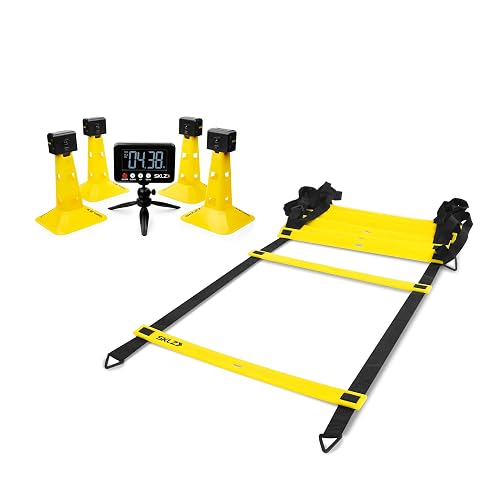
- Pairs a 15-foot rigid quick ladder of 11 rungs, each 17 inches wide, with electronic gates that time sprints up to 20 yards.
- The timer stores your most recent 50 runs, so you can track acceleration progress without a stopwatch or phone.
- Gate sensors connect with indicator lights for setup and run on 10 AA batteries, 2 per device, for portable field use.
I ran each ladder through three weeks of footwork sessions on turf, hardwood, and a concrete driveway, timing setup and teardown, checking how well the rungs held their spacing during fast lateral steps, and putting the rigid frames through repeated folds to see which stayed tangle-free.
Buying Guide
Roll-Up Nylon Ladders vs. Rigid Quick Ladders
The first decision in any agility ladder purchase is the build. Roll-up nylon ladders use flat plastic rungs threaded onto two nylon side straps; they cost under $15, weigh about a pound, and roll into a bag the size of a water bottle, which is why the Yes4All and ProsourceFit ladders dominate the budget end. The trade-off is that the rungs slide along the straps and lift in wind, so on grass you need ground stakes to keep the spacing honest. Rigid quick ladders such as the SKLZ Pro 10' use hinged plastic rails that snap into a fixed accordion frame. They hold their shape on any surface, set up in under 30 seconds with no webbing to tangle, and shrug off years of cleats, but they cost roughly 5 to 8 times as much and take up more storage space. If you train mostly indoors and value a fast, repeatable layout, pay for a rigid ladder. If you need something cheap and packable for a backyard or a gym bag, a nylon ladder does the same drills for a fraction of the price.
Picking the Right Length and Rung Count
Agility ladders are sold by rung count, and the three common sizes map to fixed lengths. An 8-rung ladder runs about 4 meters, a 12-rung ladder about 6 meters, and a 20-rung ladder about 10 meters. The 12-rung, 15-to-20-foot size is the all-around default that most athletes buy, because it gives enough consecutive rungs to build rhythm without dominating a garage or a small yard. Pick a 20-rung ladder only if you have a long, clear lane and want extended acceleration drills, since at 10 meters it needs roughly 35 feet of total run-out with deceleration space. Buy an 8-rung ladder for tight indoor spaces, young kids, or travel. Brands like Yes4All and ProsourceFit sell all three lengths under one listing, so check exactly which size a low advertised price covers before you order. The SKLZ Pro and Elevation ladders are shorter rigid units around 7 to 10 feet but connect end to end if you want to extend the run later.
Rung Spacing and Adjustability for Different Drills
Fixed-spacing ladders lock the rungs in place, while adjustable ladders let you slide them along the straps. Adjustability matters more than most buyers expect. Tight spacing near 12 inches forces rapid, choppy steps that sharpen foot speed and reaction time, while wider spacing past 16 inches trains stride length and single-leg power. Sliding-rung ladders like the Yes4All and ProsourceFit models cover both because you set the gaps yourself, which is ideal if several athletes of different sizes share one ladder. Rigid ladders such as the SKLZ Pro also adjust the distance between rungs, but within the limits of the hinged frame rather than freely. If you run a single drill set, fixed spacing is fine and faster to deploy. If you coach a mixed group or want to progress drills over a season, prioritize a ladder whose rungs move, and re-check the spacing after a few sessions because nylon straps can creep under repeated cleat strikes.
Indoor Floors vs. Outdoor Turf and Anchoring
Where you train changes which ladder works. On indoor hardwood, vinyl, or rubber gym flooring, a flat nylon ladder lies still under your own weight and rarely needs anchoring, so a $9 roll-up is enough. On grass and outdoor turf the same ladder shifts during hard lateral cuts unless you pin it down, which is why most outdoor-focused sets include 4 ground stakes, and the training-set bundle here ships with them. Rigid quick ladders solve the problem differently: their accordion frame stays put on any surface without stakes, an advantage on a paved driveway where you cannot drive a stake at all. Avoid carpet, where rungs snag and trip you. If you split time between a gym and a field, either choose a rigid ladder for surface independence or buy a nylon ladder with stakes and a carry bag so you are ready for both. Always clear the run-out zone of cones and bags before sprinting through.
Single Ladders vs. Complete Agility Training Sets
A bare ladder trains footwork, but agility is more than quick feet. Complete training sets pair the ladder with hurdles, cones, and sometimes a resistance parachute so one purchase covers a full session. The $30.99 set in our rankings adds 4 adjustable hurdles for high-knee and bounding work, 12 disc cones for cutting and shuttle drills, and a resistance parachute for resisted sprints, which together cost far less bought as a kit than separately. The downside is setup time: four accessories plus stakes take longer to lay out and pack than a single 20-foot ladder, and lower-cost bundle hurdles are less sturdy than dedicated track hurdles. Buy a set if you are starting from nothing and want a complete agility toolkit on a budget. Buy a standalone ladder, like the SKLZ Pro, if you already own cones and hurdles or you only want to drill ladder footwork and value a faster, tougher build over extra pieces.
Durability, Carry Bags, and Storage
An agility ladder lives a rough life under cleats, in car trunks, and on wet grass, so build quality decides how many seasons it lasts. Nylon ladders fail at two points: the rungs crack if you stomp the center rather than the rails, and the straps fray where they meet the rungs. Look for thick plastic rungs and reinforced stitching, and step on the rails, not the middle of a rung. Rigid ladders such as the SKLZ Pro and Elevation use hinged plastic that resists cracking and folds flat, trading a higher price for a longer service life. A carry bag is not a luxury here; it keeps a 20-foot ladder from tangling into a knot and turns a 10-meter ProsourceFit ladder into a water-bottle-sized roll. Every ladder in this guide includes a bag. For storage, hang nylon ladders coiled on a hook to avoid permanent kinks, and stand rigid frames on edge so they take up only a few inches of shelf depth.
Frequently Asked Questions
What is the best agility ladder in 2026?
For most athletes, the SKLZ Speed and Agility Ladder Pro at $72.99 is the best agility ladder of 2026. It extends to 10 feet with 7 heavy-duty hinged rungs, uses a concertina accordion fold with no nylon webbing, and sets up tangle-free in under 30 seconds, which is why it earned our top spot. The rigid frame holds its spacing on hardwood, turf, or a paved driveway without ground stakes, and the ends connect so you can link two units into a 20-foot run. If $72.99 is more than you want to spend, the Yes4All Agility Ladder starts at $8.96 and still slides to spacing between about 4 and 15 inches across 8, 12, and 20-rung sizes. Shoppers who want a full kit rather than a bare ladder should look at the $30.99 training set, which adds 4 hurdles, 12 cones, and a resistance parachute. Coaches who need timing data can step up to the $159.98 SKLZ Quick Ladder with electronic speed gates.
How much should I spend on a speed and agility ladder?
You can train effectively for under $10, so spend based on how seriously and how often you drill. Budget roll-up nylon ladders like the Yes4All at $8.96 and the ProsourceFit from $9.50 cover the same core footwork drills as anything pricier and pack into a bag the size of a water bottle, which makes them the right call for casual users, kids, and backyard sessions. Around $30, the Speed and Agility training set adds 4 hurdles, 12 cones, and a resistance parachute, a strong value if you are building an agility toolkit from scratch. Spend $60 to $75 on a rigid quick ladder such as the SKLZ Pro or Elevation if you train several times a week, want a tangle-free setup in under 30 seconds, and need the frame to survive cleats and stay put without stakes. Only coaches and serious sprinters need the $159.98 SKLZ Quick Ladder with electronic gates, since most athletes do not require sprint timing that records the last 50 runs.
What length agility ladder should I buy, 8, 12, or 20 rungs?
Match the rung count to your space and your goal. An 8-rung ladder is about 4 meters long and suits tight indoor rooms, young children, and travel, where a longer ladder would not fit. A 12-rung ladder runs roughly 6 meters, or 15 to 20 feet, and is the all-around default most athletes buy because it gives enough consecutive rungs to build rhythm without overwhelming a garage or small yard. A 20-rung ladder stretches about 10 meters and is best only if you have a long, clear lane for extended acceleration work, since it needs around 35 feet of total space once you include deceleration room. The Yes4All and ProsourceFit ladders sell all three sizes under one listing, so confirm exactly which length a low advertised price like $8.96 or $9.50 actually covers before ordering. If you are unsure, start with the 12-rung size; it handles the widest range of footwork and sprint drills for adults.
Are flat nylon ladders or rigid quick ladders better?
Each wins in a different situation, so the better choice depends on surface and budget rather than one being universally superior. Flat nylon ladders, like the Yes4All at $8.96 and the ProsourceFit from $9.50, use plastic rungs on two nylon straps; they cost under $15, weigh about a pound, and roll up small, but the rungs can slide and lift in wind, so on grass you need the 4 ground stakes to hold spacing. Rigid quick ladders, like the SKLZ Pro at $72.99, use a hinged accordion frame that holds its shape on any surface, sets up in under 30 seconds with no webbing to tangle, and lasts years under cleats. The catch is price and bulk: rigid units cost 5 to 8 times more and take more storage room. Choose nylon for cheap, packable indoor use, and choose rigid if you train often, want a repeatable layout, or drill on a driveway where stakes will not go in.
Can I use an agility ladder indoors on hardwood or carpet?
Hardwood and gym flooring are ideal, but carpet is a problem. On indoor hardwood, vinyl, or rubber gym surfaces, a flat nylon ladder like the Yes4All lies still under your own body weight and rarely needs anchoring, so a $9 roll-up ladder works without stakes you could not use indoors anyway. Rigid quick ladders such as the SKLZ Pro also sit flat on hardwood and have the bonus of staying put on slick surfaces because the accordion frame does not depend on friction with the floor. Avoid carpet whenever possible: the rungs catch on the pile, the ladder bunches up, and the snag can trip you mid-drill. If carpet is your only option, choose a rigid ladder over a nylon one because its raised frame is less likely to fold under your foot. Indoors, always leave at least 6 to 8 feet of clear run-out at each end so you can decelerate safely after sprinting through the rungs.
Do agility ladders actually improve speed and footwork?
Yes, with realistic expectations about what they train. Ladder drills build coordination, rhythm, body control, and the rapid foot strike and lift frequency that translate into quicker first steps and cleaner direction changes, which is why nearly every soccer, basketball, and football program uses them. What a ladder does not do by itself is increase top-end straight-line speed; that requires sprint and strength work, which is why the $30.99 training set pairs the ladder with a resistance parachute and the $159.98 SKLZ system adds gates that time sprints up to 20 yards. For best results, run 2 to 3 short ladder sessions a week, focus on clean, fast contacts rather than just finishing the ladder, and progress from simple in-and-out steps to lateral and crossover patterns. Used 3 times weekly alongside sprints and lower-body strength training, an agility ladder is one of the cheapest tools for sharpening footwork, especially the under-$15 Yes4All and ProsourceFit ladders.
What accessories come with agility ladder training sets?
Training sets bundle the ladder with the extra pieces a full agility session needs. The $30.99 Speed and Agility set in our rankings is a good example: alongside the 20-foot, 12-rung ladder it includes 4 adjustable hurdles for high-knee and bounding drills, 12 disc cones for cutting and shuttle patterns, 1 resistance parachute for resisted sprints, and 4 ground stakes to anchor the ladder on grass. Some larger kits add a jump rope, push-up handles, or resistance bands, though those extras vary by listing and are often the first parts to feel flimsy. Standalone ladders keep things simple: the SKLZ Pro at $72.99 ships only the ladder and a carry bag, on the assumption you already own cones and hurdles. Buy a set if you are starting from nothing and want every tool at once for under $35; buy a bare ladder if you only want footwork drills or you prefer to choose sturdier hurdles and cones separately later.
How do I keep an agility ladder from sliding during drills?
A sliding ladder ruins drill spacing and can trip you, so anchoring depends on your surface. On grass or outdoor turf, push the included 4 ground stakes through the loops at each corner of a nylon ladder like the Yes4All or the $30.99 training set, which pins the straps so hard lateral cuts do not drag the rungs out of position. On a paved driveway where stakes will not go in, a rigid quick ladder such as the SKLZ Pro is the better answer because its accordion frame holds its shape under its own weight and does not need anchoring at all. Indoors on hardwood or rubber, most ladders stay put without help, but you can add a few small pieces of gym tape at the corners if a slick floor lets it creep. Whatever the surface, lay the ladder fully taut before you start, leave 6 to 8 feet of run-out, and re-check the spacing every few minutes since repeated foot strikes can shift sliding rungs.
Our Verdict
For most athletes, the SKLZ Speed and Agility Ladder Pro at $72.99 is the agility ladder to buy: it extends to 10 feet with 7 adjustable hinged rungs, sets up tangle-free in under 30 seconds, and holds its spacing on any surface without stakes. If you only need cheap, packable footwork training, the Yes4All Agility Ladder starting at $8.96 runs the same drills and rolls into a bag the size of a water bottle. Buyers starting from scratch should consider the $30.99 training set, which adds 4 hurdles, 12 cones, and a resistance parachute, while coaches who want sprint data can step up to the $159.98 SKLZ Quick Ladder with electronic speed gates that time runs up to 20 yards.
Sources
- Physical Activity Guidelines for Americans — U.S. Department of Health and Human Services
- Physical Activity Basics — Centers for Disease Control and Prevention
- Agility and Change-of-Direction Training — National Strength and Conditioning Association